World In Brief · Senior Edition
June 20, 2026
Plug-in panels are getting popular—how do we make sure they’re safe?

The balcony solar boom is coming to the US

Imagine plugging a small solar panel into your apartment balcony outlet and watching your electricity bill drop. That's the idea behind 'balcony solar' – tiny, easy-to-install solar systems that are already super popular in Europe. Now, they're about to hit the US in a big way.

More than two dozen US states are considering laws to let people install these plug-in panels. They're small – about the size of a coffee table – and can generate up to 800 watts, enough to run a microwave. Supporters say they could help renters and apartment dwellers access solar power, cutting both emissions and energy costs.

But there's a catch: safety. These systems plug directly into wall outlets, which can cause problems. Joseph Bablo, an engineer at the testing lab UL Solutions, explains three main risks:

1. Circuit overload: Normal circuit breakers might not work properly when solar power is feeding back into the same circuit, potentially causing damage or fires.

2. Wet outlets: Outdoor outlets have safety features that shut off power when wet. But those features may fail if solar power is flowing back into the outlet from the panel.

3. Shock hazard: If you unplug a solar panel while it's in sunlight, the metal prongs could stay 'live' with electricity for longer than usual, posing a shock risk.

To address these concerns, UL Solutions released a new safety standard (UL 3700) in January 2025. The key recommendation? Use a special outlet designed specifically for solar panels. That means most people would still need an electrician to install the right wiring – so the 'no electrician needed' promise isn't quite here yet.

Today, no plug-in solar system has been fully certified under the new standard. But experts think it's still a promising way to make solar power more accessible – as long as it's done safely.

So, balcony solar is coming. The question is: will your apartment be ready?

Think Critically
The article says balcony solar could help renters, but requires a special outlet that needs an electrician. Do you think this is a fair trade-off for safety, or does it defeat the purpose of 'easy solar' for people who can't afford an electrician? Use evidence from the text.
See It Differently
Imagine you're a utility company executive. Why might you be worried about thousands of people plugging in solar panels without your permission? What problems could it cause for the power grid, even if the panels are small?
Write About It
Write a short letter (3-5 sentences) to your local state representative arguing for or against allowing balcony solar in your state. Use at least one safety concern or benefit from the article.
What do the numbers really say about the impact of artificial intelligence on the labor market? The answer might surprise you.

A reality check on the AI jobs hysteria

Haven't you heard? White-collar jobs are going away, decimated by AI. Waves of layoffs in the tech sector (most recently at Coinbase and Meta and Cisco) are said to presage what will soon come for all of us knowledge workers. But before you quit your job as a software developer or financial analyst—or tech journalist—and look to join the plumbers' union, it's worth considering today's economic research on whether artificial intelligence has actually begun to devour white-collar work.

The short answer is: No.

Despite the warning by some of an imminent jobs apocalypse that will destroy much of if not most such work, or the rumblings about a 'permanent underclass,' there's scant evidence that AI has yet had any large-scale impact on the US labor market.

Analysis of the data gathered for the US Bureau of Labor Statistics (BLS) shows that the unemployment rate for the jobs potentially most affected by AI is actually lower than that for occupations less exposed to the technology. And, critically in the mind of economists, there are no signs that large numbers of people are shifting from jobs threatened by AI to supposedly safer ones, such as those involving mostly manual labor.

While the current labor statistics don't preclude a sudden job upheaval in the coming years, they do throw doubt on the inevitability of the doomsday scenarios and the pace at which they'd unfold. Everyone in the AI community, it seems, is predicting that the technology will soon wipe out jobs, and everyone, it also seems, knows some young wannabe workers who can't find one. Perhaps we haven't seen any major disruption in the labor market statistics yet, people often say, but just wait.

But maybe we should pay attention to what the data is showing us. And right now, the numbers paint a picture of a relatively stable labor market in which AI disruptions remain largely speculative.

'It could be disruptive, but the data is telling us right now that disruption is not yet here, and we have time to plan.'

'All of the available evidence to date suggests that AI's impact on current labor market conditions is likely small right now,' says Erika McEntarfer, a labor economist who headed the BLS until President Trump fired her last fall after a jobs report that displeased the administration. (Not surprisingly, BLS reports of sluggish job growth have continued since her dismissal.)

McEntarfer, who is now a fellow at the Stanford Institute for Economic Policy Research, says the relatively small impact that AI is having so far on today's labor market 'surprises many people, but it shouldn't. What we know from history is that it takes time for innovations to work their way through changes in industries and changes in occupations. AI is unlikely to transform labor markets until it first transforms businesses.'

McEntarfer points to US Census data showing that only one in five companies are using AI in any business function. 'The data are a great reality check on the fear that AI will be enormously disruptive,' she says. 'It could be. It likely will be disruptive, but the data is telling us right now that disruption is not yet here, and that we have time to plan.'

Things ain't great—but the question is why

The US job market, to be sure, sucks for many, especially younger would-be workers. Unemployment rates for recent college graduates stand at around 5.6%, well above the level for all workers. It's a rate not seen since the pandemic and the years immediately after the 2008 recession. Even more troubling is that hiring rates have been particularly dismal during the post-covid economy, a trend that hits hard at young people trying to enter the workforce. If you're a recent college graduate and looking for a tech job, no one, it can seem, is hiring.

There are signs that AI is contributing to the pain for the 22-to-25-year-olds seeking jobs in software development and other occupations that are feeling a big impact from AI. But these professions represent just a sliver of the overall labor market. What's more, it's uncertain how much blame AI should get for the job woes. Similarly unknown is whether the loss of entry-level jobs in AI-exposed occupations is a harbinger of what's coming for others or simply an isolated symptom of what economists refer to as a 'low-fire, low-hire' labor market caused by a variety of macroeconomic forces.

Insights into these uncertainties will tell us much about our working fates in the transition to an AI economy. There are no shortage of confident assertions and predictions about what is about to happen; while some people forecast the end of work, others say economic history teaches us that technology advances always lead to more and better jobs eventually.

The honest answer is that no one knows for sure what AI will bring and whether this time will be different. To help figure it out, we need better and far more comprehensive data.

The statistics gleaned from the federal government's monthly survey of 60,000 households for the BLS provide a broad overview of the changes to the labor market, while academics and even some AI companies have begun trying to gain a more granular view of specific jobs that are being affected. But the existing data-gathering tools don't adequately explain how AI is affecting the huge and diverse US labor market.

There's a long list of questions that we don't have the data to fully answer. How is AI being used in the workplace? Does the increased use of AI mean the technology will replace workers, or will it make them more productive and valuable? Which occupations and skills are most affected? Who is in most peril from the changes? As David Deming, a professor of economics at Harvard University, puts it: 'We're sort of flying blind.'

To gather more insight into some of these questions, Deming and his colleagues have been surveying several thousand people every three months since 2024, asking them basic questions: Do you use generative AI, and how often? Does it save you time at work? Tracking the answers over time gives the economists important clues (it's used by a little over 40% of workers but adoption varies by sectors) and allows them to estimate productivity gains (they've found some, but nothing economy-shaking). It has also helps document how quickly AI has been adopted in the workplace and how it compares with earlier technologies such as the PC and the internet (the pace has been faster but roughly in the same ballpark).

It's far from a complete picture of how AI is changing work. But it provides some intriguing results; for example, a fair number of workers in manufacturing and other industrial sectors have tried AI. Deming's results show that while businesses in general might be relatively slow to formally adopt the technology, lots of their employees are using it.

Getting a picture of these early adopters and how they're using AI provides a 'crystal ball for the future of the labor market,' Deming says. 'It gives you important clues about how it's going to be used tomorrow, and who's going to be affected, and who's going to be harmed and how do we need to get ready for it. It's a diagnostic of what's coming down the road.'

But what it doesn't tell you is the fate of various jobs.

The young are most vulnerable

Analysis of how AI will affect jobs typically begins with identifying so-called exposure of various occupations to the technology. This approach is based on the idea that any given job is a collection of tasks. By evaluating which tasks can be performed by, say, the latest large language model, researchers gauge an occupation's overall exposure. A small army of economists have created a slew of such studies, meticulously

think critically
The article argues that AI hasn't caused mass job loss yet, but many people believe it will. Based on the evidence given—like only one in five companies using AI and unemployment being lower in AI-exposed jobs—do you think the public's fear is justified or overblown? Support your opinion with at least two facts from the text.
see it differently
Imagine you are a recent college graduate struggling to find a tech job. How might your personal experience shape your view of the article's claim that 'disruption is not yet here'? What does this tell us about the difference between individual stories and overall data?
write about it
Write a short paragraph (3-5 sentences) from the perspective of a high school student in 2026 who is choosing a career path. Based on the article, would you pursue a job in a field heavily exposed to AI, like software development, or one less exposed, like plumbing? Explain your reasoning using at least one piece of evidence from the text.
As tools like Claude Code get better, more and more developers are happy to hand off coding tasks to them. The way software gets built has changed for good.

Anthropic's Code with Claude showed off coding's future—whether you like it or not

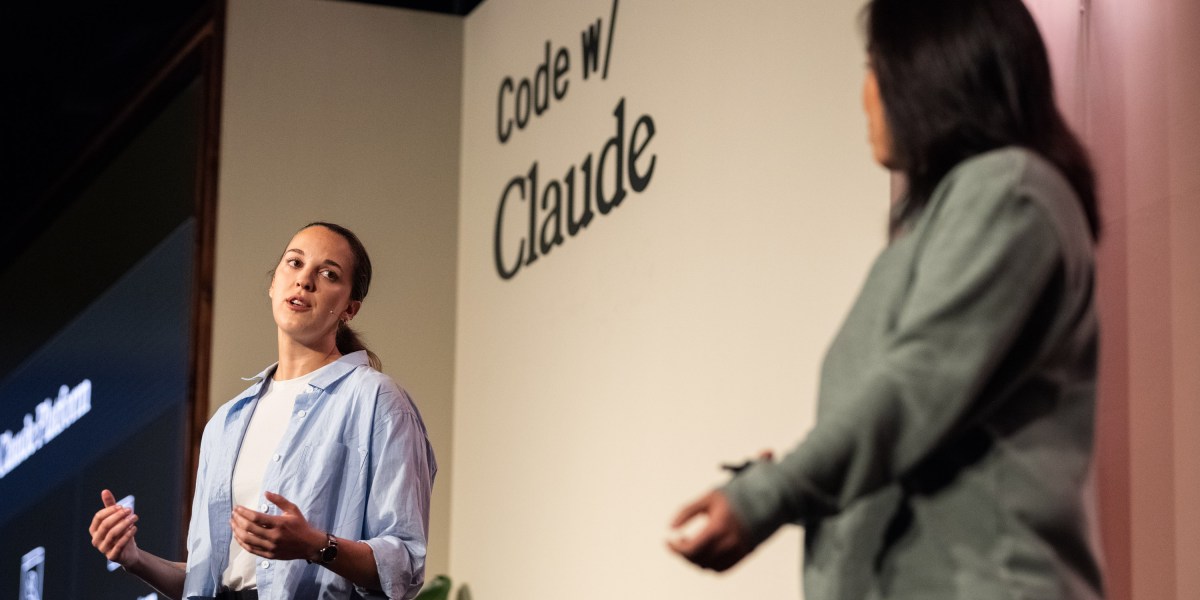
The vibes were strong at Code with Claude, Anthropic's two-day event for software developers in London that kicked off on May 19, the same day as Google's I/O in Palo Alto. (A coincidence, not a flex, Anthropic staffers assured me.)

'Who here has shipped a pull request in the last week that was completely written by Claude?' Jeremy Hadfield, an engineer at Anthropic, asked from the main stage. Almost half the people in the packed room—many sitting with laptops on their knees, coding or prompting as they watched the talks—raised their hands.

Pull requests are fixes or updates to existing software that are submitted for review before they go live. They are the bread and butter of software development, the chunks of code that most professional developers spend their lives writing—or did until now.

'Who here has shipped a pull request that was completely written by Claude where they did not read the code at all?' Hadfield asked next. Nervous laughter. Most of the hands stayed up.

It's not news that LLM-powered tools like Anthropic's Claude Code and OpenAI's Codex have upended the way software gets made. Top tech companies now like to boast of how little code their developers write by hand. ('Most software at Anthropic is now written by Claude,' Hadfield said. 'Claude has written most of the code in Claude Code.') OpenAI, Google, and Microsoft make similar claims. Many others wish they could.

Even so, it is striking how normal this new paradigm already seems, and how fast it has set in. This was the second year that Anthropic has put on developer events, which also run in San Francisco and Tokyo. This time last year, the company had just released Claude 4. It could code, kind of. But with Anthropic's latest string of updates—especially Claude 4.6 and then 4.7, released in February and April—Claude Code is a tool that more and more developers seem happy to hand their work off to.

Anthropic says its goal is to push automation as far as it will go. Instead of using AI to generate code and then having humans clean it up and fix the mistakes, it wants Claude to check and correct its own work. 'The default isn't 'I'm going to prompt Claude'—the default is now 'I'm going to have Claude prompt itself,'' Boris Cherny, who heads Claude Code, said in the opening keynote.

If all goes well, human developers shouldn't even see the error messages when something doesn't work. That will all be handled by Claude, which will test and tweak, test and tweak, until everything runs as it should. As Ravi Trivedi, an engineer at Anthropic, put it in another talk: 'The key principle is getting out of Claude's way. We like to say: 'Let it cook.''

Trivedi presented a new feature in Claude Managed Agents, Anthropic's cloud-based setup for building and running multi-agent systems, announced two weeks ago, which the company calls dreaming. Claude agents write notes to themselves, recording and saving useful information about specific tasks. When another coding agent, say, starts to work on the same code that others have worked on, it can use the notes they left behind to get up to speed faster and learn from any errors those previous agents may have made.

Dreaming is a system that Claude agents can use to read through the notes and consolidate the information they contain, spotting patterns and common issues across different tasks. In theory, dreaming should help coding agents learn about a particular code base and get better and better at working on it.

Success stories

Code with Claude is an event aimed at developers. As well as product showcases and hands-on workshops from Anthropic, there were how-tos from a range of companies that have reshaped their software development teams around Claude Code, including Spotify and Delivery Hero as well as Lovable, Base44, and Monday.com—three startups vibe-coding apps that help people vibe-code apps.

There were no signs of unease at Code with Claude. Everybody I met wanted in.

And yet outside the conference there have been a number of reports that many coders are starting to question this bright new future. Some gripe in online forums like Reddit and Hacker News that AI coding tools are being pushed by managers chasing productivity gains, when in practice the technology makes software development harder because of all the extra code developers now have to review. 'The only people I've heard saying that generated code is fine are those who don't read it,' a user called pron posted on Hacker News last week.

Others claim that their coding abilities have fallen off as they hand more tasks to AI. And researchers have warned that AI tools can produce unsafe code that will make software more vulnerable to attacks.

I sat down with Claude engineering lead Katelyn Lesse and Claude product lead Angela Jiang and asked them what they made of the concerns that a sudden flood of code generated (and shipped) without proper human oversight was kicking serious security and maintenance problems down the road.

'All of the old software development best practices still apply. They've applied this entire time,' said Lesse. 'I think there are a lot of people and teams that may have lost sight of them in this moment.'

And yet as Anthropic and others push for greater automation and tools like Claude Code improve, the temptation increases to offload more and more tasks, including oversight. Lesse told me that some of the technical managers at Anthropic are exhausted by keeping up with all the code their teams now produce. 'Part of things happening so much more quickly is just managing your time,' she said.

'I think that right now Claude is probably as good as a midlevel engineer at writing code,' she added. You still need expert engineers to design a system and troubleshoot harder problems, she said. 'But over time we want Claude to get better and better at all different types of engineering.'

Jiang agreed: 'I think the absolute end state we're trying to get to is Claude basically being able to build itself.'

Think Critically
Do you think it's a good idea for developers to let AI write code they don't even read? Use evidence from the article to support your argument.
See It Differently
What if the same trend happened in other fields like writing essays, diagnosing illnesses, or designing buildings? Would you trust AI to do those tasks without human oversight?
Write About It
Write a short response (4-5 sentences) from the perspective of a senior software engineer who is worried about losing their coding skills because they rely too much on AI.
✻ ✻ ✻
📝 Read & Respond
Read. Think. Write.
1 Comprehension Check
1. Based on "The balcony solar boom is coming to the US", what is the main idea of this article? Write one sentence.
2. Based on "A reality check on the AI jobs hysteria", what is the main idea of this article? Write one sentence.
3. Based on "Anthropic's Code with Claude showed off coding's future—whether you like it or not", what is the main idea of this article? Write one sentence.
4. What evidence does the article provide to support its main argument?
2 Vocab Builder
WordDefinition / Sentence
...
Write a word from this week's reading that was new to you:
...
Use it in a sentence:
...
Write another word and its definition:
...
Use it in a sentence:
3 Critical Thinking
The article says balcony solar could help renters, but requires a special outlet that needs an electrician. Do you think this is a fair trade-off for safety, or does it defeat the purpose of 'easy solar' for people who can't afford an electrician? Use evidence from the text.
4 See It Differently
Imagine you're a utility company executive. Why might you be worried about thousands of people plugging in solar panels without your permission? What problems could it cause for the power grid, even if the panels are small?
5 Quick Write
Write a short letter (3-5 sentences) to your local state representative arguing for or against allowing balcony solar in your state. Use at least one safety concern or benefit from the article.