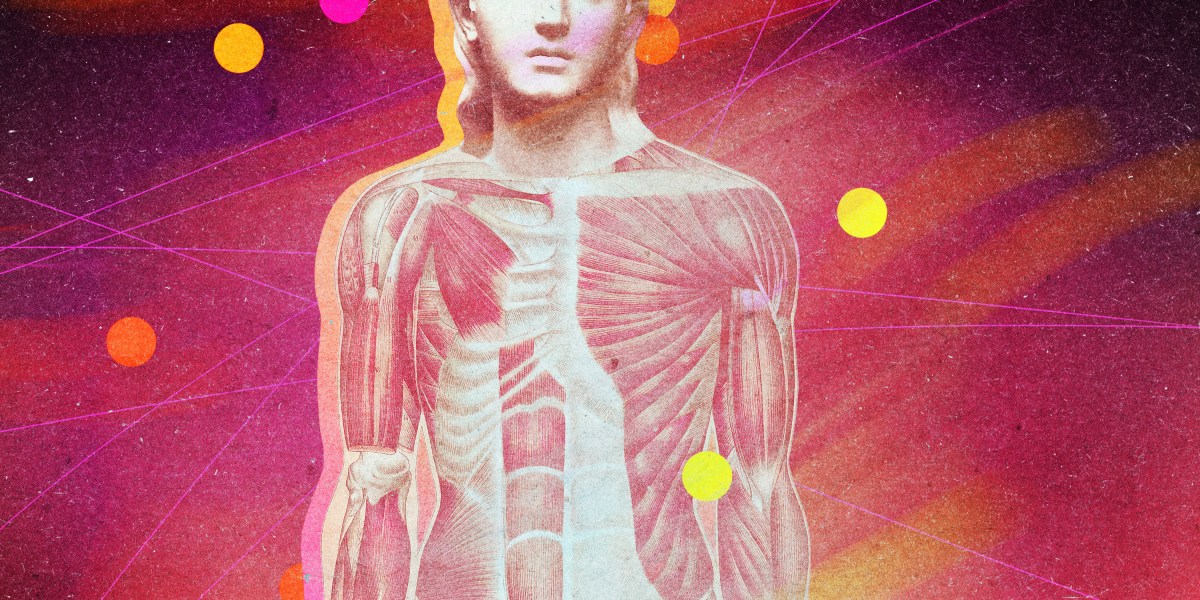
Your brain lives in the dark space of your skull. Yet it knows when the wind lifts the hairs on your skin, when your heart is racing, when your gut tightens with fear. It is also, right now, predicting what you will read next as your eyes move across this page. It is picking up signals that help it make sense of what is happening around you and prepare you to act if you need to stay safe. You are not usually aware that your brain is doing all that.
Our senses take in information at a staggering rate—roughly 11 million bits flood in every second from our skin, eyes, ears, and more. That is nearly three paperback novels worth of data every second. Only a sliver reaches our conscious awareness. Researchers estimate that our conscious minds can process roughly 10 to 60 bits of information per second, about the rate at which you are reading this sentence. That is a ratio of about one conscious bit to hundreds of thousands of unconscious bits.
And that is a mercy. As Moriah Thomason, a neuroscientist at NYU Langone, says, "Thank goodness we are built like this. There is a layer of what we have access to in conscious awareness. And then we have a right-under-the-surface amount. There is only a certain amount we are meant to 'hold in mind' in order to function successfully."
What you are aware of: Your stomach growling when you are hungry. Your palms sweating before you speak in public. The breath you just took, if you pay attention to it. Even your heartbeat, which some people can sense from the inside without feeling their pulse in their wrist.
Scientists have a word for how we sense ourselves from the inside: interoception.
The term was coined in 1906 by the British neurophysiologist Charles Sherrington. For most of the 20th century it remained largely confined to textbooks. Today, thanks to a 2021 Nobel Prize and new tools that can map the interoceptive system across the body, the study of this facility is suddenly quite hot. As researchers decode how signals move between body and brain, a clearer picture is starting to take shape—with implications for how we understand and treat conditions from obesity to chronic pain to anxiety.
The field began to take off in the 1990s. In 1994, the neurologist Antonio Damasio published a book with a pointed title: Descartes' Error. He challenged the historical separation of thinking and feeling, arguing that our ability to choose and act is driven by feelings, and those feelings in turn are shaped by the body's signals, such as your gut clenching or your skin going clammy. When we lose that connection between feeling and thinking, as one of Damasio's patients did after surgery to treat a brain tumor, we may still be able to reason with perfect logic about the pros and cons of traveling on a Tuesday or a Wednesday. But without the emotional signals that help us predict what a choice will feel like, our reason spins and circles, and we cannot decide.
A contemporary of Damasio's, the neuroscientist Bud Craig, spent his career asking one question: How do you feel? He charted how the brain builds an inner map of the body and updates it in real time every moment you are alive.
Think of the captain's bridge on the USS Enterprise, where a live map displays the status of the ship's critical systems: oxygen levels, energy availability, hull integrity, shield strength. Another set of indicators senses things outside the ship: asteroid belts, enemy ships, radiation, life signs, and spatial anomalies not yet understood.
Your brain, only about the size of your two fists pressed together, creates a map like this for your entire body, along with a map of the outside world, from data streaming in through your five senses. Together, they feed into your brain's working model of you in the world, now and across time—where you are, who you are, your expectations for what is about to happen (based on everything you know), and what all that means for you.
When someone asks "How are you doing?" we consult our maps and report back on our status. We might say we are happy, depleted, anxious, or energetic. These feelings are always a braid of emotional and physical sensations. They are what your interoceptive navigational system serves up to your awareness when you sense yourself from the inside.
As we grow up, we learn to interpret what these sensations mean—interpretations that, in turn, can alter our physiology, emotions, and behavior. Research by the psychologist Alia Crum shows that people who embrace a "stress is enhancing" mindset produce more growth hormones than people who have a "stress is debilitating" mindset. They also experience more positive emotions and greater cognitive flexibility.
Language also matters. We learn words for the textures of our feelings—words that then shape how we feel and act. The psychologist Marc Brackett points out that people low in "emotional granularity"—the ability to distinguish between closely related feelings—react more impulsively under stress and are less able to find meaning in difficult experiences. But mindsets and emotional intelligence are malleable. We can learn that "anxious" is different from "terrified," and we can even reframe how we interpret our body's sensations. Instead of thinking of the butterflies in our bellies as annoying, we can welcome them as our body's way of preparing us for a peak performance.
Research by the neuroscientist Lisa Feldman Barrett, who discovered and named emotional granularity, suggests that it is not about describing or labeling emotions. It is about how our brains construct emotions with more or less specificity, often outside of awareness.
Scientists have long understood that the interoceptive information informing these lived experiences travels via two major systems: nerves and humors (blood and lymph). Now they are actively studying a third system—the "interstitium," a network of fluid-filled spaces woven throughout the body's connective fascia that may also play a role in communication.
But until recently, scientific understanding of this interoceptive system looked like a high-level schematic that left out vital details—how information travels from the outside environment in, how it moves from your body to your brain, and how it is integrated and interpreted within your brain. Researchers are now racing to explore what the neuroscientist Catherine Tallon-Baudry calls this "new continent of awareness."
The wandering highway
One of the most active areas of research centers on the vagus nerve, the main component of the parasympathetic nervous system and an information highway carrying news from your organs up to your brain and back down to your body. The vagus has become a celebrity nerve, ubiquitous in wellness podcasts and trauma therapy. "Tone your vagus nerve." "Activate your parasympathetic system." The language suggests a single thing you can target, like a muscle. The reality, as Steve Liberles at Harvard Medical School is discovering, is far more interesting.
Liberles has spent most of his career mapping what he calls "the great wide unknown" of one of our largest and longest nerves. He speaks the way he works—methodically, without overselling. But the questions driving him are huge. How do we sense our body's inner state? What information flows through which channels? And how does the brain decide what to do with it?