← Back to index
Homework Review · Senior
Senior
Good
2026-06-28 · Space and Earth Exploration · Reviewed June 28, 2026
✅ Strengths
- Exceptional creative writing in the See It Differently section — immersive narrative with effective dialogue
- Ability to draw personal connections across cultures (Beijing vs London climate)
- Clear argument structure in Critical Thinking (two supporting points)
- Reading comprehension is solid — understood all three articles
- Vocabulary shows ambition (renaissance, dwarf, drill-and-blast)
💪 Areas to Improve
- Spelling vigilance: check common words (global, coldest, ambient, biological)
- Vocab Builder: verify word forms in a dictionary (dread → dreaded, not 'were dread')
- Quick Write: develop the 'why' question further — don't stop at 'it makes me wonder'
- Critical Thinking: include a 'however' paragraph (what might critics say?)
📝 Exercise Review
Comprehension Check
Completeness: complete · Accuracy: good
All three articles addressed. Key concepts identified correctly.
Vocab Builder
Completeness: complete · Accuracy: fair
Words defined with example sentences. 'Abient' is misspelled (should be 'ambient'). 'Dread' usage is grammatically off ('were dread' → 'dreaded').
Critical Thinking
Completeness: complete · Depth: surface
Agrees with the article and gives two reasoning points (body heat regulation, social withdrawal). Good structure but lacks counter-argument or deeper analysis.
See It Differently
Completeness: complete · Accuracy: good
Excellent narrative writing. Uses descriptive sensory details (foggy goggles, booming sounds). The dialogue with the worker shows real insight. The closing reflection about 'the light of human' is thoughtful and mature.
Quick Write
Completeness: complete · Depth: fair
Interesting personal connection drawn between London heatwave and Beijing's cold summer. Raises a genuine question about regional climate differences. Could develop the global warming argument further.
📸 Homework Images
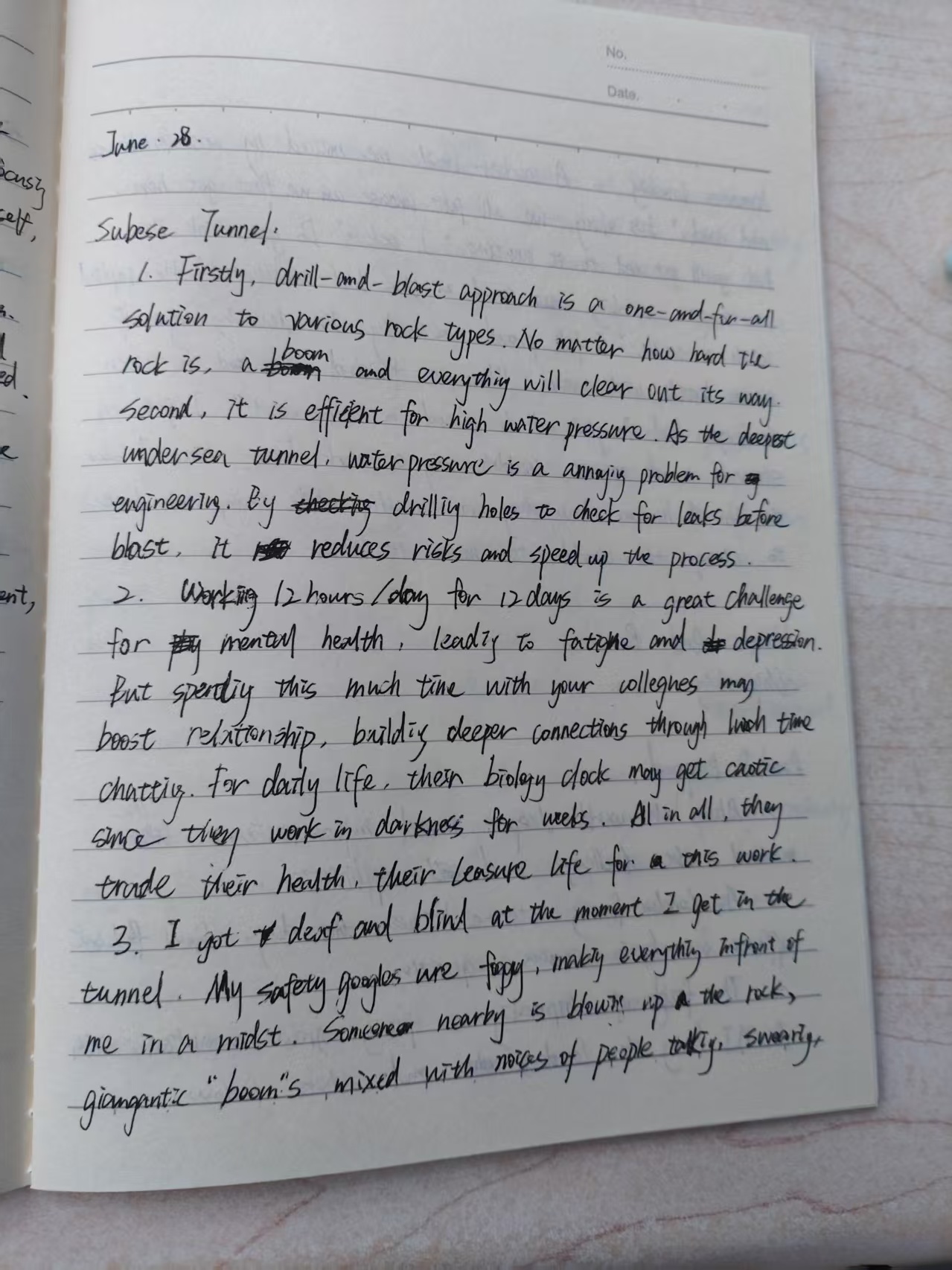
June 28.

Subese Tunnel.

1. Firstly, drill-and-blast approach is a one-and-for-all solution to various rock types. No matter how hard the rock is, a boom and everything will clear out its way. Second, it is efficient for high water pressure. As the deepest undersea tunnel, water pressure is a annoying problem for engineering. By drilling holes to check for leaks before blast, it reduces risks and speed up the process.

2. Working 12 hours/day for 12 days is a great challenge for mental health, leading to fatigue and depression. But spending this much time with your colleagues may boost relationship, building deeper connections through long time chatting. For daily life, their biology clock may get chaotic since they work in darkness for weeks. All in all, they trade their health, their leisure life for this work.

3. I got deaf and blind at the moment I get in the tunnel. My safety goggles are foggy, making everything in front of me in a midst. Someone nearby is blowing up the rock, giangantic 'boom's mixed with voices of people talking, swearing.
Subsea Tunnel comprehension (Q1-3) + narrative opening. Key facts captured well. A few spelling errors (Subese → Subsea, giangantic → gigantic).
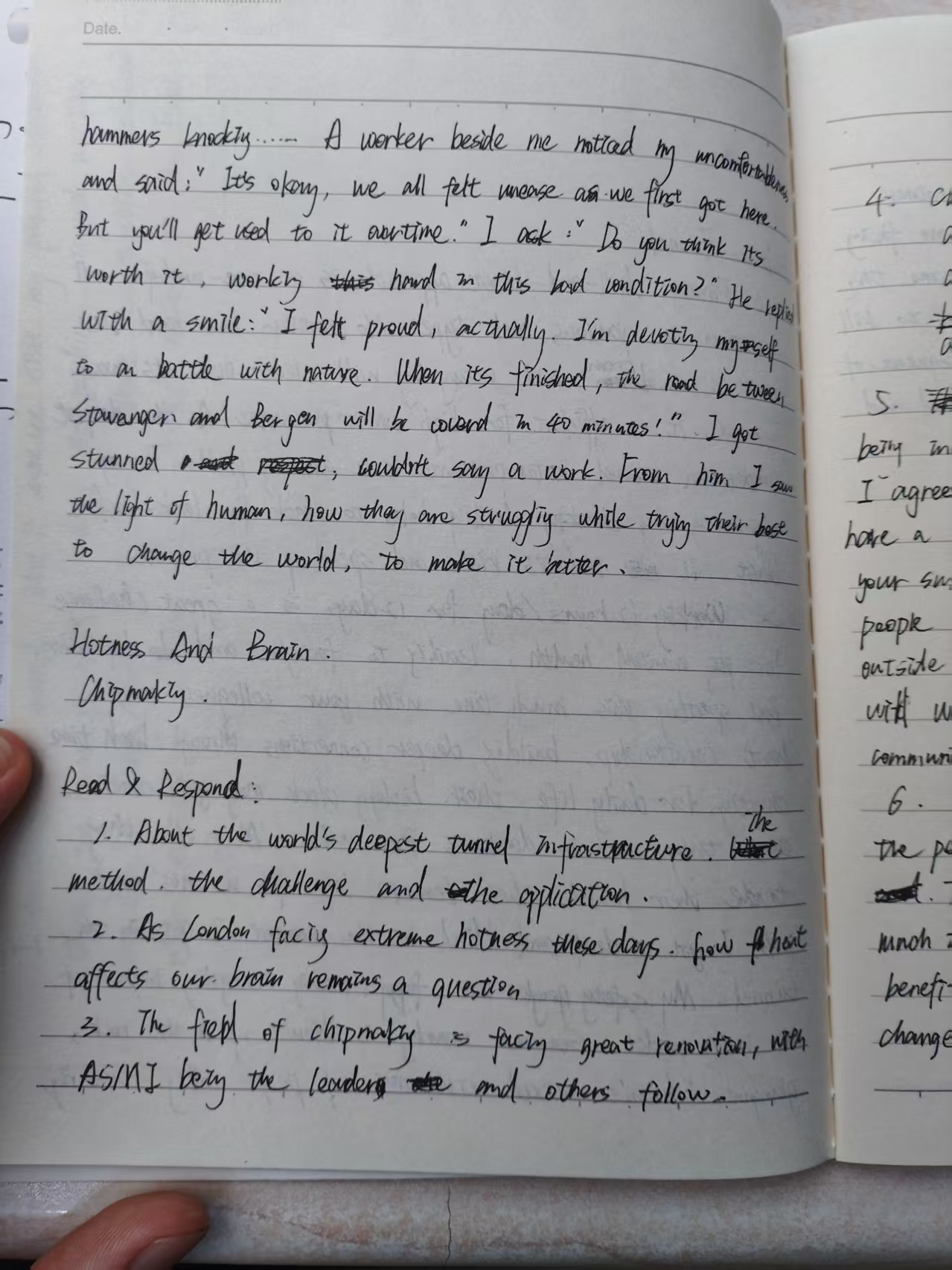
hammers knocking...... A worker beside me noticed my uncomfortableness and said: 'It's okay, we all felt unease as we first got here. But you'll get used to it overtime.' I ask : 'Do you think it's worth it, working hard in this hard condition?' He replied with a smile: 'I felt proud, actually. I'm devoting myself to an battle with nature. When it's finished, the road between Stavanger and Bergen will be covered in 40 minutes!' I got stunned, couldn't say a work. From him I saw the light of human, how they are struggling while trying their best to change the world, to make it better.

Hotness And Brain.
Chipmaking.

Read & Respond:
1. About the world's deepest tunnel infrastructure. the method, the challenge and application.
2. As London facing extreme hotness these days, how heat affects our brain remains a question.
3. The field of chipmaking is facing great renovation, with ASML being the leader and others follow.
Strong narrative continuation — dialogue with worker is vivid and shows deep understanding. Read & Respond summaries are concise. Section 4-6 incomplete (bottom of page cut off).
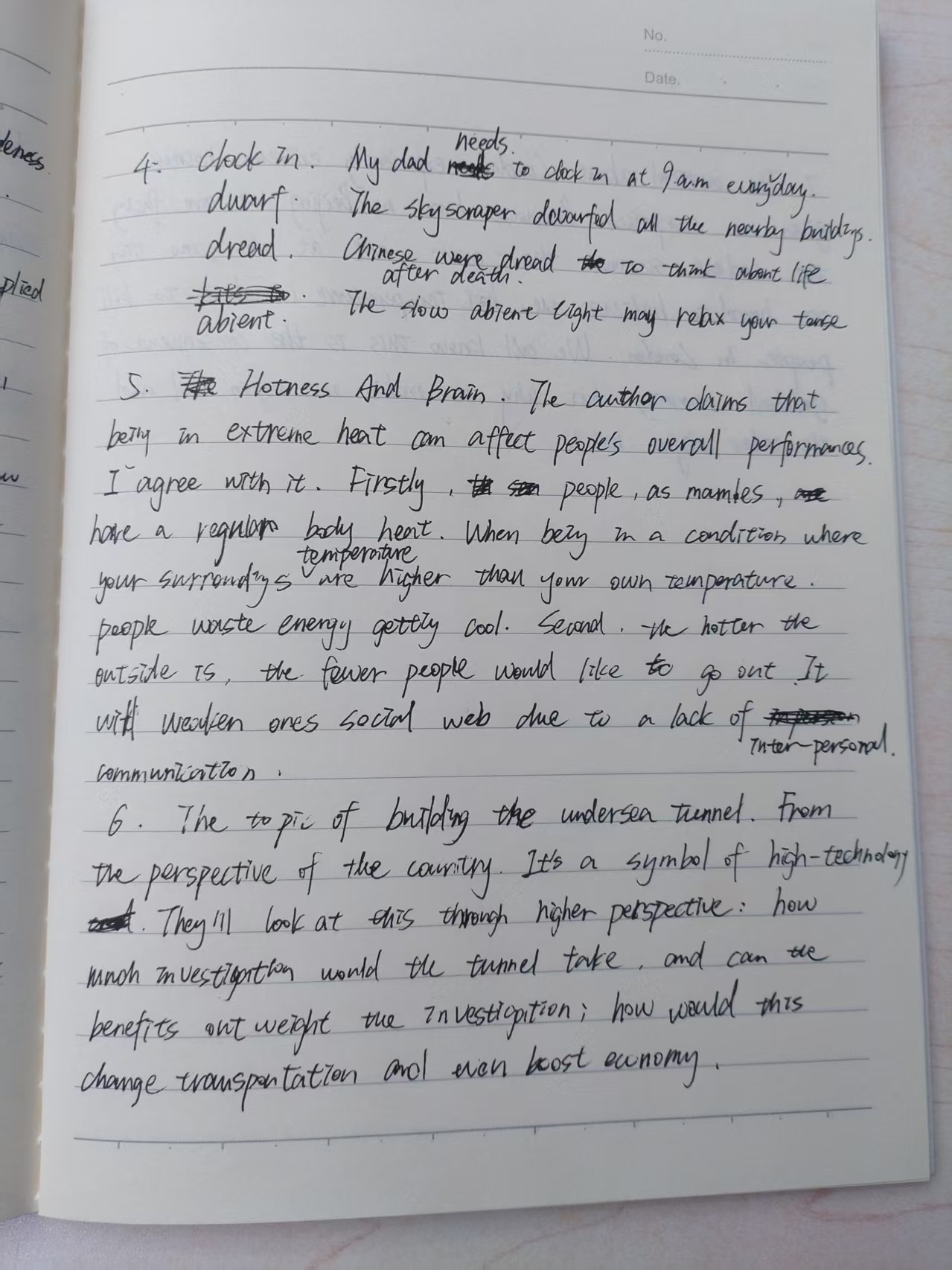
4. clock in. My dad needs to clock in at 9 a.m. everyday.
dwarf. The skyscraper dwarfed all the nearby buildings.
dread. Chinese were dread to think about life after death.
abient. The slow abient light may relax your tense

5. Hotness And Brain. The author claims that being in extreme heat can affect people's overall performances.
I agree with it. Firstly, people, as mammals, have a regular body heat. When being in a condition where your surroundings temperature are higher than your own temperature. People waste energy getting cool. Second, the hotter the outside is, the fewer people would like to go out. It will weaken ones social web due to a lack of inter-personal communication.

6. The topic of
Vocab Builder: 'dread' usage is grammatically off (should be 'dreaded'), 'abient' misspelled (ambient). Critical Thinking: two-point argument with good logic (body regulation + social withdrawal). Section 6 cut off.
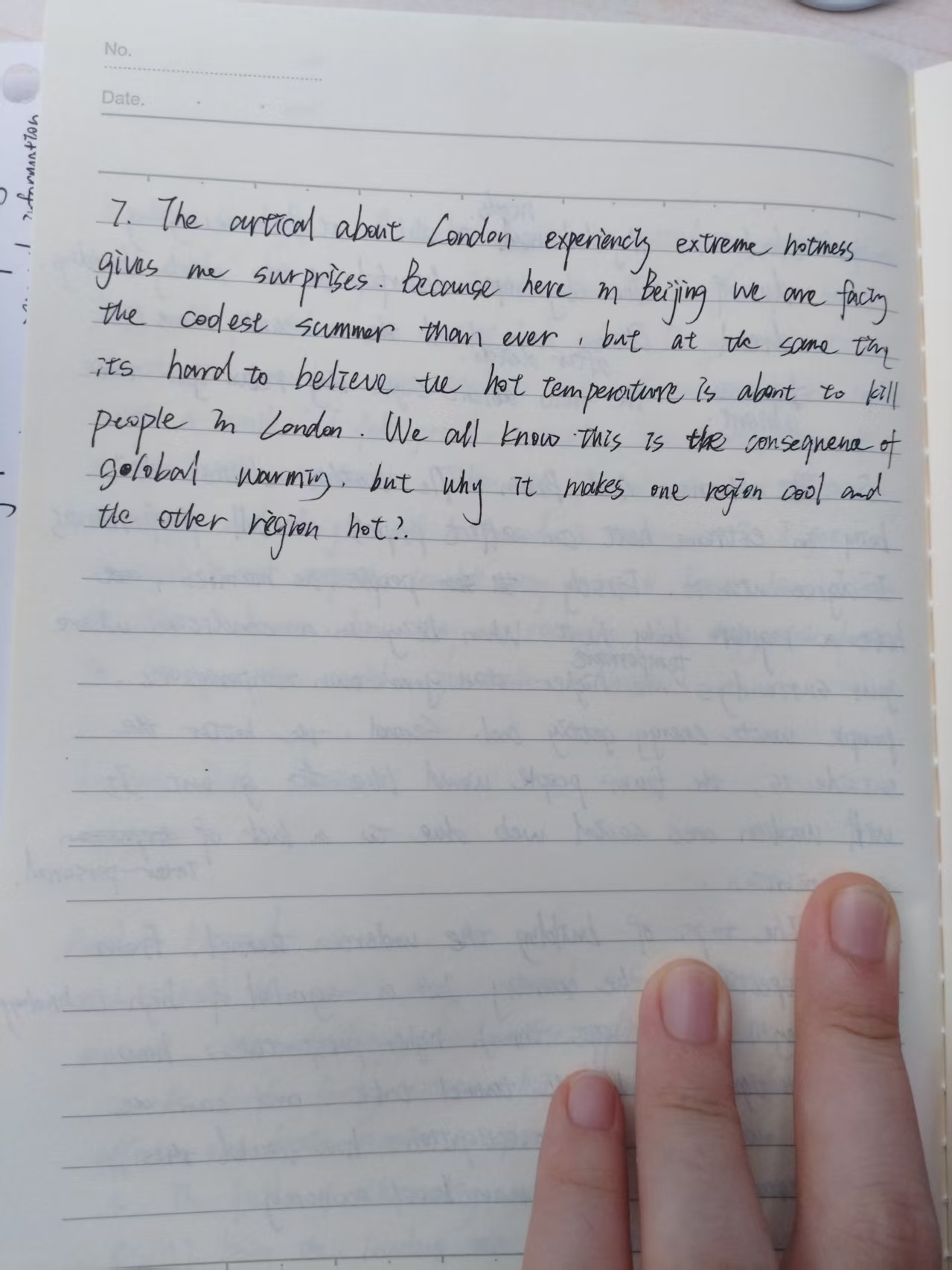
7. The artical about London experiencing extreme hotness gives me surprises. Because here in Beijing we are facing the codest summer than ever, but at the same time it's hard to believe the hot temperature is about to kill people in London. We all know this is the consequence of golobal warming, but why it makes one region cool and the other region hot?
Quick Write: Interesting cross-cultural comparison (Beijing vs London). Raises a genuine scientific question about regional climate effects. Spelling: artical→article, codest→coldest, golobal→global.
✏️ Grammar & Spelling
| Original | Correction |
|---|
| abient light | ambient light |
| Chinese were dread to think | Chinese dreaded to think |
| a ongoing battle | an ongoing battle |
| speed up the process | speeds up the process (subject-verb agreement) |
| hotness | heat (hotness is non-standard) |
| codest summer | coldest summer |
| golobal warming | global warming |
| ones social web | one's social web |
| their biology clock | their biological clock |
📝 Transcribed Text
Click to expand each section.
Comprehension Check
Read & Respond:
1. About the world's deepest tunnel infrastructure: the method, the challenge and application.
2. As London facing extreme hotness these days, how heat affects our brain remains a question.
3. The field of chipmaking is facing great renovation, with ASML being the leader and others follow.
Vocab Builder
4. clock in. My dad needs to clock in at 9 a.m. everyday.
dwarf. The skyscraper dwarfed all the nearby buildings.
dread. Chinese were dread to think about life after death.
abient. The slow abient light may relax your tense.
Critical Thinking
5. Hotness And Brain. The author claims that being in extreme heat can affect people's overall performances.
I agree with it. Firstly, people, as mammals, have a regular body heat. When being in a condition where your surroundings temperature are higher than your own temperature. People waste energy getting cool. Second, the hotter the outside is, the fewer people would like to go out. It will weaken ones social web due to a lack of inter-personal communication.
See It Differently
Subsea Tunnel first-person narrative (Pages 1-2):
Firstly, drill-and-blast approach is a one-and-for-all solution to various rock types. No matter how hard the rock is, a boom and everything will clear out its way. Second, it is efficient for high water pressure. As the deepest undersea tunnel, water pressure is an annoying problem for engineering. By drilling holes to check for leaks before blast, it reduces risks and speed up the process.

Working 12 hours/day for 12 days is a great challenge for mental health, leading to fatigue and depression. But spending this much time with your colleagues may boost relationship, building deeper connections through long time chatting. For daily life, their biology clock may get chaotic since they work in darkness for weeks. All in all, they trade their health, their leisure life for this work.

I got deaf and blind at the moment I get in the tunnel. My safety goggles are foggy, making everything in front of me in a midst. Someone nearby is blowing up the rock, gigantic 'boom's mixed with voices of people talking, swearing, hammers knocking... A worker beside me noticed my uncomfortableness and said: 'It's okay, we all felt unease as we first got here. But you'll get used to it over time.' I ask: 'Do you think it's worth it, working hard in this hard condition?' He replied with a smile: 'I felt proud, actually. I'm devoting myself to a battle with nature. When it's finished, the road between Stavanger and Bergen will be covered in 40 minutes!' I got stunned, couldn't say a word. From him I saw the light of human, how they are struggling while trying their best to change the world, to make it better.
Quick Write
7. The article about London experiencing extreme hotness gives me surprises. Because here in Beijing we are facing the coldest summer than ever, but at the same time it's hard to believe the hot temperature is about to kill people in London. We all know this is the consequence of global warming, but why it makes one region cool and the other region hot?