← Back to index
Homework Review · Senior
Senior
Good
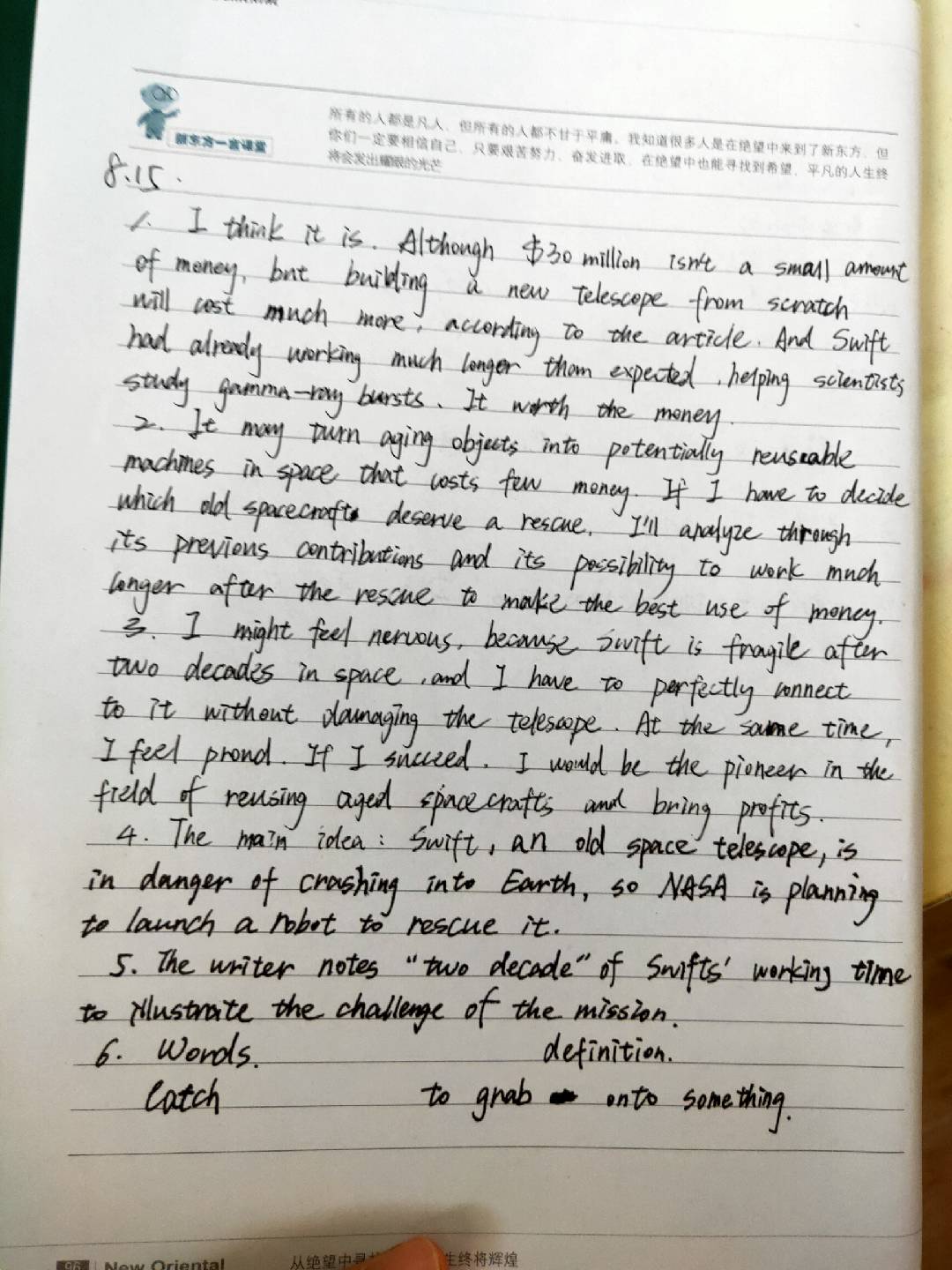
2026-08-15 · Responding to a NASA article about the Swift Observatory rescue: judging the cost-effectiveness of the $30 million mission, rethinking the reuse of aging spacecraft, and writing a first-person narrative from the rescue robot LINK's point of view. · Reviewed September 13, 2026
✅ Strengths
- All four written tasks and both vocabulary items were attempted — no blank sections, which shows consistent effort.
- Article evidence is used, not invented: the $30 million cost, the cost of building a new telescope, Swift's extended service life, gamma-ray bursts, and the telescope's fragility are all genuine details from the text.
- The main-idea sentence (item 4) is concise and captures the who/what/why accurately.
- The Quick Write correctly uses first-person narration from LINK's perspective and includes both required elements (emotions and technical challenges).
- Register is generally appropriate for argumentative writing, and discourse markers like 'At the same time' and 'If I have to decide' show developing organization.
💪 Areas to Improve
- Proofread for verb forms: 'had already working,' 'It worth the money,' and 'If I succeed, I would be' are all missing or mismatched verbs.
- Avoid double connectors — 'Although ..., but ...' is a very common Chinese-English error; use only one.
- Watch countable/uncountable nouns and plural agreement: 'few money' → 'little money'; 'that costs' → 'that cost'; 'spacecrafts' → 'spacecraft.'
- Copy quotations exactly from the article: 'two decade' and 'Swifts'' should be 'two decades' and 'Swift's.'
- Strengthen the evidence question (item 5) by giving two article-supported reasons instead of one, and make sure the evidence actually supports the main argument (cheaper than replacement; five more years of data).
- Push critical thinking further: discuss the risk side (LINK burns up, Swift was never designed to be grabbed) and the 'first time ever' significance.
- Make the short story an actual story — add sensory detail, a moment of danger, and numbers from the article (three arms, 224 to 373 miles, late August) rather than only stating feelings.
- Expand vocabulary notes with more target words from the article (orbit, gamma-ray burst, fragile, extend, latch) and use them in your own sentences.
📝 Exercise Review
Comprehension Check
Completeness: complete · Accuracy: good
The one-sentence main idea is accurate and well condensed: it names Swift, the danger of re-entry, and NASA's robotic rescue plan — matching the article's core. Minor flaw: the article states the Swift Boost Mission launched on July 3, 2026, so 'is planning to launch a robot to rescue it' is slightly out of date. Suggest: 'The main idea: Swift, an old space telescope, is slowly sinking toward Earth, so NASA is sending a robot, LINK, to push it into a safer orbit.' Also consider mentioning the larger point in the article — 'a whole new way to keep important science alive' — to show you caught the broader argument.
Vocab Builder
Completeness: partial
Item 5 answers the evidence question weakly: the student offers only one detail ('two decades') and it illustrates the mission's *challenge*, not the main argument. Stronger evidence from the article would be: '$30 million is much cheaper than building a new telescope from scratch' and 'Swift could keep collecting data for at least five more years.' Suggest: 'The article supports its argument with two points: the $30 million rescue is far cheaper than building a new telescope, and Swift could keep working for at least five more years.' Item 6 is a definition list, but the word chosen is off-target — the article uses 'latch onto it,' not 'catch.' Suggest: 'latch (onto) — to fasten or attach yourself firmly to something.' Note also 'two decade' should be quoted as 'two decades' and the possessive is 'Swift's.'
Critical Thinking
Completeness: complete · Depth: fair
The student takes a clear position ('I think it is') and backs it with two real article claims — the $30 million cost versus building new, and Swift's longer-than-expected service studying gamma-ray bursts. That is solid, evidence-based reasoning for Grade 9. Depth is only fair because the cost/benefit side is not pushed further: nothing about the 'at least five more years' of data, the 'burn up in the atmosphere' loss of LINK, or the article's statement that this is 'the first time NASA has tried to extend an aging spacecraft's life with a robot.' Rewrites needed: 'Although $30 million isn't a small amount of money, but building a new telescope from scratch will cost much more' → Suggest: 'Although $30 million isn't a small amount of money, building a new telescope from scratch would cost much more.' 'And Swift had already working much longer than expected' → Suggest: 'And Swift has already been working much longer than expected.' 'It worth the money.' → Suggest: 'It is worth the money.' Also note NASA is not a business, so 'worth the money' is fine, but phrase it as 'worth the investment.'
See It Differently
Completeness: complete · Depth: fair
Both halves of the prompt are addressed: the change in thinking about aging objects in space, and the engineer's criteria (past contributions + remaining working potential). The criteria are sensible, but the idea could be sharpened with article-based specifics, e.g., 'is it fragile / was it designed to be grabbed?' and the Hubble example. Language problems distort meaning in places: 'potentially reuseable machines' → 'reusable' (drop the 'e'); 'machines in space that costs few money' → Suggest: 'machines in space that cost very little' (plural subject needs 'cost,' and 'money' is uncountable so 'few' is wrong); 'I'll analyze through its previous contributions' → Suggest: 'I'll consider its previous contributions.' Putting it together: 'This mission could show that aging objects in space are worth repairing instead of replacing. If I were an engineer, I would weigh two things: what the spacecraft has already contributed and how many more years it could realistically work after a rescue.'
Quick Write
Completeness: complete · Depth: fair
The short story is written in first person and does include both required elements — feelings (nervous, proud) and challenges (Swift's fragility, the need for a perfect connection). That said, it is more of a summary of emotions than a story; it lacks sensory detail and the specific technical facts the article supplies, like LINK's three arms, the 224-mile to 373-mile boost, or the August meeting date. Language issues: 'I have to perfectly connect to it' → Suggest: 'I have to connect to it perfectly' (avoid splitting the infinitive awkwardly); 'If I succeed, I would be the pioneer' → Suggest: 'If I succeed, I will be the pioneer' (mixed conditional — 'if' + present takes 'will'); 'aged spacecrafts' → 'aged spacecraft' (same singular/plural form); 'bring profits' → Suggest: 'prove that old machines still have value' (NASA does not earn profit; the article talks about saving money, not making it). Try opening with action: 'My three arms tremble as Swift's silver hull fills my camera view, and I remind myself that one wrong touch could end twenty years of science.'
📸 Homework Images
所有的人都是凡人,但所有的人都不甘于平庸,我知道很多人是在绝望中来
到了新东方,但你们一定要相信自己,只要艰苦努力,奋发进取,在绝望中也能
找到希望,平凡的人生终将会发出耀眼的光茫
8.15.
1. I think it is. Although $30 million isn't a small amount
of money, but building a new telescope from scratch
will cost much more, according to the article. And Swift
had already working much longer than expected, helping scientists
study gamma-ray bursts. It worth the money.
2. It may turn aging objects into potentially reuseable
machines in space that costs few money. If I have to decide
which old spacecraft deserve a rescue, I'll analyze through
its previous contributions and its possibility to work much
longer after the rescue to make the best use of money.
3. I might feel nervous, because Swift is fragile after
two decades in space, and I have to perfectly connect
to it without damaging the telescope. At the same time,
I feel proud. If I succeed, I would be the pioneer in the
field of reusing aged spacecrafts and bring profits.
4. The main idea: Swift, an old space telescope, is
in danger of crashing into Earth, so NASA is planning
to launch a robot to rescue it.
5. The writer notes "two decade" of Swifts' working time
to illustrate the challenge of the mission.
6. Words.
Catch
definition.
to grab onto something.
New Oriental
从绝望中身
终将辉煌
Content accuracy is strong across all four answered tasks: the student correctly identifies the $30 million price tag, the cheaper-than-building-new argument, Swift's two-year design life versus twenty years of service, its study of gamma-ray bursts, and its fragility after two decades — all of which are genuine article claims. The main idea statement (item 4) is clear and accurate, though the article says NASA has already launched the Swift Boost Mission, so 'is planning to launch' should be 'is sending' or 'has launched'. Fluency is generally good but there is noticeable L1 interference in a few places: 'analyze through its previous contributions' (drop 'through'), 'that costs few money' (money is uncountable and the subject is plural), and 'bring profits' (NASA is not a profit-seeking company; the article frames savings, not profit). Tense control slips in 'Swift had already working' and 'It worth the money,' both of which are missing a verb form. Quotes from the article are also slightly mis-copied: 'two decade' and 'Swifts'' should be 'two decades' and 'Swift's'. The vocabulary item is thin and slightly off-target — the article's key word is 'latch (onto),' not 'catch.' Overall this is solid comprehension work with careless mechanical errors; the priority is verb forms, countable/uncountable nouns, and proofreading quoted text.
✏️ Grammar & Spelling
| Original | Correction |
|---|
| reuseable | reusable |
| spacecrafts | spacecraft |
| Although ... , but building a new telescope | Although ... , building a new telescope (remove 'but') |
| Swift had already working | Swift has already been working / had already been working |
| It worth the money. | It is worth the money. |
| that costs few money | that cost very little / that cost little money |
| I'll analyze through its previous contributions | I'll analyze its previous contributions |
| I have to perfectly connect to it | I have to connect to it perfectly |
| If I succeed, I would be the pioneer | If I succeed, I will be the pioneer |
| bring profits | save money / prove the value of the mission |
| "two decade" of Swifts' working time | "two decades" of Swift's working time |
| so NASA is planning to launch a robot to rescue it | so NASA is sending a robot to rescue it (the mission already launched on July 3, 2026) |
| Catch — definition: to grab onto something | latch (onto) — to fasten or attach firmly to something (the article's word is 'latch') |
| 光茫 | 光芒 |
📝 Transcribed Text
Click to expand each section.
Comprehension Check
4. The main idea: Swift, an old space telescope, is in danger of crashing into Earth, so NASA is planning to launch a robot to rescue it.
Vocab Builder
5. The writer notes "two decade" of Swifts' working time to illustrate the challenge of the mission.
6. Words. Catch — definition: to grab onto something.
Critical Thinking
1. I think it is. Although $30 million isn't a small amount of money, but building a new telescope from scratch will cost much more, according to the article. And Swift had already working much longer than expected, helping scientists study gamma-ray bursts. It worth the money.
See It Differently
2. It may turn aging objects into potentially reuseable machines in space that costs few money. If I have to decide which old spacecraft deserve a rescue, I'll analyze through its previous contributions and its possibility to work much longer after the rescue to make the best use of money.
Quick Write
3. I might feel nervous, because Swift is fragile after two decades in space, and I have to perfectly connect to it without damaging the telescope. At the same time, I feel proud. If I succeed, I would be the pioneer in the field of reusing aged spacecrafts and bring profits.