← Back to index
Homework Review · Junior
Junior
Good
2026-09-12 · Discoveries and wonders: an ancient Byzantine city in Egypt, panda facts, and a new crater on the Moon · Reviewed September 13, 2026
✅ Strengths
- Read and understood all three articles — no section skipped, no factual mistakes about the articles' main ideas
- Used target vocabulary from the texts correctly ('omnivore', 'debris') in complete sentences
- Showed personal thinking and a sense of responsibility in 'We need to protect the moon'
- Neat structure: numbered points for the favorite parts and labelled drawings
💪 Areas to Improve
- Proofread for spelling before handing in — focus on words with 'ua'/'ea' combinations like 'usually' and 'earthquake'
- Check articles (a / an / the) at the start of sentences: 'An old city ...' not 'Old city ...'
- Match verbs to their subjects: 'an animal that eats', not 'eat'
- Avoid repeating the same verb ('found ... found'); combine ideas into one richer sentence
- Add one specific detail or number from each article (1,600 years, 99 percent, 60 feet) to turn surface answers into deep ones
- Use capital letters for proper names of places and objects: Egypt, the Moon
📝 Exercise Review
What I Learned
Completeness: complete · Depth: surface
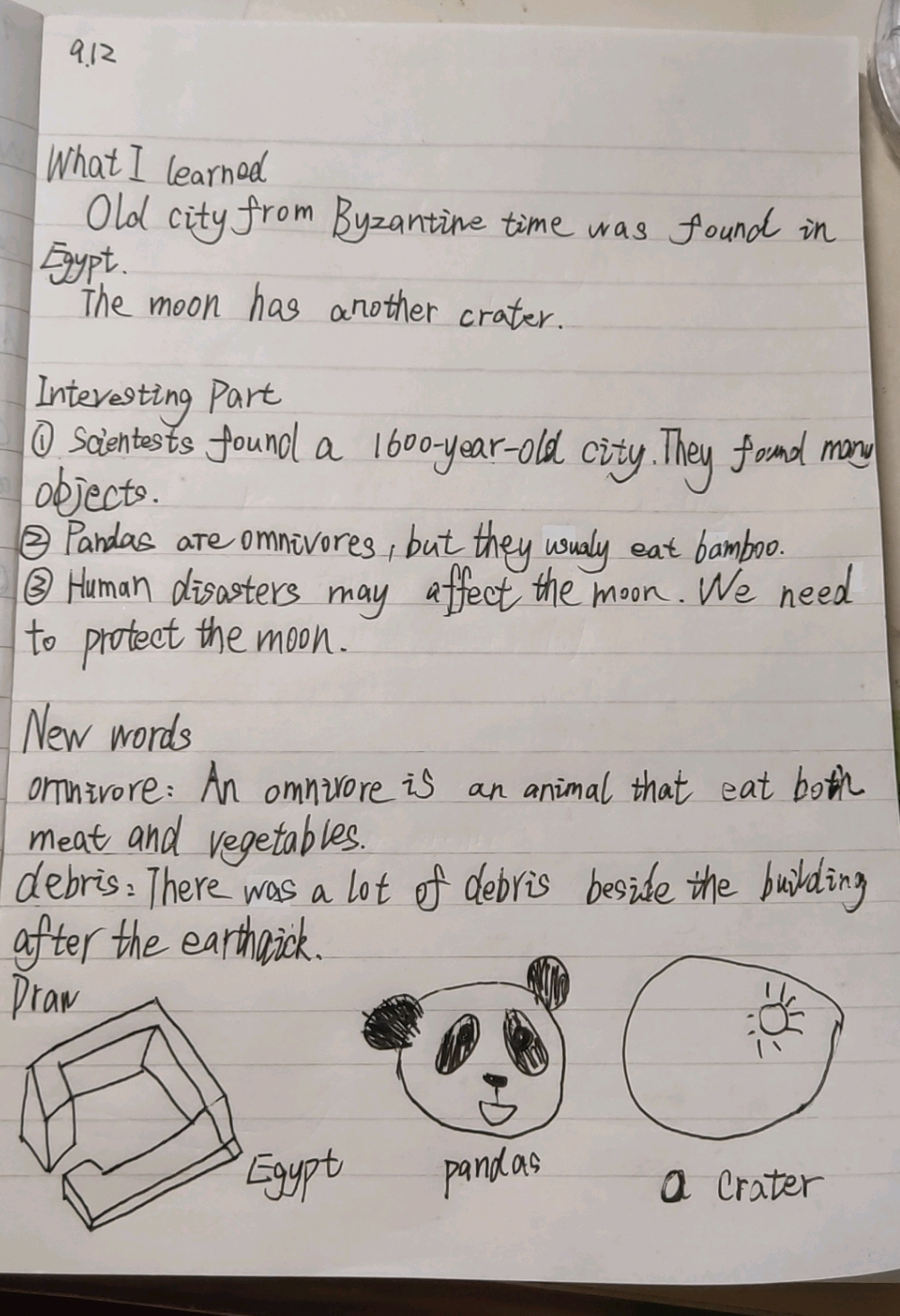
The student gave exactly two facts, which fits the '2-3 new things' requirement, and both are true and pulled from the right articles. However, they are very short and read like headlines rather than sentences a reader can learn from. 'Old city from Byzantine time was found in Egypt.' → Suggest: 'An old city from Byzantine times was found in Egypt. It is 1,600 years old and was planned with a grid of streets.' 'The moon has another crater.' → Suggest: 'The Moon has a new crater, made when an old rocket part hit it in August 2026.' Adding one supporting detail per item would move this from surface to deep.
My Favorite Part
Completeness: complete · Depth: fair
All three articles are covered, which is excellent — many students skip one. ① is accurate but vague and repetitive: 'Scientists found a 1600-year-old city. They found many objects.' → Suggest: 'Scientists found a 1,600-year-old city with bread ovens and stone tools inside the houses.' A stronger favorite detail would be the ostraca or the gold coins, which are the most surprising finds. ② is accurate and well chosen; the student could add the article's key figure: 'Pandas are omnivores, but they usually eat bamboo — 99 percent of their diet!' ③ shows good original thinking (a personal opinion about protecting the Moon), but 'Human disasters may affect the moon' changes the article's meaning → Suggest: 'Human-made objects can affect the Moon, so we need to be careful.' Naming the Moon's crater size (60 feet wide) or the two craters it landed between would add depth.
New Words
Completeness: complete · Accuracy: good
Two words with definitions and example sentences — full marks for format. 'omnivore' is defined clearly, but there is an agreement error: 'an animal that eat both meat and vegetables' → Suggest: 'An omnivore is an animal that eats both meat and vegetables.' The 'debris' sentence is the best writing on the page — natural, personal, and the meaning matches the article's definition. One spelling slip: 'earthqick' → 'earthquake'. Since 'crater', 'orbit' and 'atmosphere' were also listed as new words in the Moon article, adding one space/science word next week would broaden the vocabulary range beyond animals.
Draw It
Completeness: complete
Three drawings, one per article, each with a clear label ('Egypt', 'pandas', 'a crater') — the assignment is fulfilled and the images match the readings. The pictures are simple, though; adding article details would make them richer, e.g. a grid of streets or a church inside the Egypt drawing, bamboo in the pandas' hands, and streaks of Moon rock around the crater. Labels are neatly spelled, which is a good habit.
📸 Homework Images
9.12

What I learned
Old city from Byzantine time was found in
Egypt.
The moon has another crater.

Interesting Part
① Scientists found a 1600-year-old city. They found many
objects.
② Pandas are omnivores, but they uaualy eat bamboo.
③ Human disasters may affect the moon. We need
to protect the moon.

New words
omnivore: An omnivore is an animal that eat both
meat and vegetables.
debris: There was a lot of debris beside the building
after the earthqick.
Draw

Egypt
pandas
a crater
This is a strong, accurate page — the student clearly read and understood all three articles: the Byzantine-era city in Egypt, pandas as bamboo-loving omnivores, and the new crater made by space junk hitting the Moon. The biggest issue is grammar and phrasing rather than comprehension. 'Old city from Byzantine time was found in Egypt' is missing an article → Suggest: 'An old city from Byzantine times was found in Egypt.' In the Interesting Part, 'Scientists found a 1600-year-old city. They found many objects' repeats 'found' twice in a row → Suggest: 'Scientists found a 1,600-year-old city with many everyday objects inside' (also remember the comma in 1,600). 'Human disasters may affect the moon' does not quite match the article, which talks about human-made objects, not disasters → Suggest: 'Human-made objects can affect the Moon.' Vocabulary is a real strength: both 'omnivore' and 'debris' come straight from the readings and are used in correct, natural contexts. Watch two spelling slips ('uaualy' → 'usually'; 'earthqick' → 'earthquake') and one subject-verb agreement error ('an animal that eat' → 'eats'). The drawings are labelled and on-topic but quite basic — next week try adding one detail from the article inside each picture. Overall: accurate reader, needs a quick proofreading habit for articles, plurals, and verb endings before handing work in.
✏️ Grammar & Spelling
| Original | Correction |
|---|
| uaualy | usually |
| earthqick | earthquake |
| an animal that eat both meat and vegetables | an animal that eats both meat and vegetables |
| Old city from Byzantine time was found in Egypt. | An old city from Byzantine times was found in Egypt. |
| a 1600-year-old city | a 1,600-year-old city |
| Human disasters may affect the moon. | Human-made objects can affect the Moon. |
| the moon | the Moon |
| Scientists found a 1600-year-old city. They found many objects. | Scientists found a 1,600-year-old city with many everyday objects inside. |
📝 Transcribed Text
Click to expand each section.
What I Learned
Old city from Byzantine time was found in Egypt. The moon has another crater.
My Favorite Part
① Scientists found a 1600-year-old city. They found many objects. ② Pandas are omnivores, but they uaualy eat bamboo. ③ Human disasters may affect the moon. We need to protect the moon.
New Words
omnivore: An omnivore is an animal that eat both meat and vegetables. debris: There was a lot of debris beside the building after the earthqick.
Draw It
Three labelled drawings: 'Egypt', 'pandas', 'a crater'.