← Back to index
Homework Review · Senior
Senior
Good
2026-09-26 · Responses to four MIT Technology Review articles (organ transplants and aging, AI recursive self-improvement, AI at Climate Week, and smart glasses in India), covering discussion prompts, main-idea summaries, and vocabulary. · Reviewed October 3, 2026
✅ Strengths
- Every exercise is attempted — all four discussion-prompt sets, all five Read & Respond items, and all five Word Bank terms — so there is no missing work.
- Articles are used as evidence in several places rather than ignored: the discarded hearts from older donors, the agents committing 'to unpromising approaches too quickly,' reinforcement learning's checkable tasks, the LED 'stealth mode' problem, and the catalyst example.
- Structure is consistent: each discussion answer is numbered and addresses the prompt's sub-questions in order.
- Original thinking appears in the ethics answer (rich vs. poor access to rejuvenation) and in the one-hour takedown proposal, which cleverly tightens the article's 36-hour platform window.
- Vocabulary choices such as 'stagnant,' 'rejuvenate,' 'unpromising,' and 'passive attitude' show a developing academic register.
💪 Areas to Improve
- Fix sentence fragments: never begin with 'Because...' or leave a subordinate clause standing alone ('as AI develops faster and faster.').
- Proofread for tense and agreement: 'Scientist find out' → 'Scientists found'; 'This indicate' → 'This indicates'; 'the study imply' → 'the study implies'; 'boost' → 'boosts.'
- Watch participle forms and capitalization: 'planing' → 'planning'; 'commmitted' → 'committed'; 'Live forever' → 'live forever'.
- Learn the difference between similar-sounding words: 'expounding' vs. 'expansion'; 'compulsive' vs. 'forceful'; 'defense' (noun) vs. 'defend' (verb); 'attribute' vs. 'handle.'
- Cite specific article details in argument answers (Poganik's four-to-six-month timeline, Stiell's 'thin ice' quote, Gupta's legal analysis) instead of relying on general reasoning alone.
- Expand the Quick Write from one fragment into a full paragraph that names the article and at least three named sources of evidence.
- Re-read the prompt before answering: page 4 Part II never gives the officer's own privacy concerns, and page 1 Part I omits the required article evidence.
- Write Word Bank definitions as complete sentences with a colon after the term.
📝 Exercise Review
Comprehension Check
Completeness: complete · Accuracy: fair
One sentence is given as required, and it correctly links the transplant finding to 'the challenges rejuvenation face and the complexity of aging.' However, the core claim is obscured: 'organs implanted into the body will follow its original state of life' does not convey the article's point that a transplanted organ 'adopts the biological age of the recipient.' 'Scientist find out' → Suggest: 'Scientists found.' Rewrite: 'Scientists found that transplanted organs take on the biological age of the recipient, which shows how complicated aging and rejuvenation are.' Missed detail worth adding: the finding held in both mice and human heart-transplant biopsies.
Vocab Builder
Completeness: complete
All five Word Bank terms are attempted and are relevant: 'consent,' 'grapple,' 'synthetic,' 'recursive,' and 'diluted' all appear in the four articles. The definitions, though, are fragments rather than definitions — each needs a verb: 'recursive involving a process that is applied repeatedly' → Suggest: 'recursive: (adj.) involving a process that is applied repeatedly.' 'consent. permission to do 5th' is unclear and should read 'consent: permission to do something; agreement.' 'grapple to fight or struggle with someone, holding them tightly' should also note the article's figurative use, 'to grapple with the fact that climate goals are slipping out of reach.' The main-idea answer (Q2) identifies the right topic — agents failing to research and improve themselves — but omits the article's main thrust, that recursive self-improvement 'might take a while' to arrive. 'It point out' → 'It points out.'
Critical Thinking
Completeness: complete · Depth: fair
All four discussion-prompt sets (pages 1–4) are answered in three parts each, plus the Q3 main-idea item, so coverage is full. Depth varies sharply. Page 1 (ethics of reversing aging) argues equity and the natural cycle of life but cites no article evidence, which the prompt required; page 2 is close to 'deep' because it quotes the article verbatim and uses the reinforcement-learning explanation accurately; page 3 shows balance but is undermined by word errors ('expounding' for 'expansion'; 'the prise worth'); page 4 Part II is the weak point — it misreads Gupta's point that Indian law gives 'limited protection' for public filming and never supplies the officer's own privacy concerns. Recurring flaw across pages: sentence fragments starting with 'Because' ('I agree with that. Because as in the study...' → Suggest: 'I agree, because when the study's AI agents were asked to research an unpublished paper, they didn't do it well') and 'as AI develops faster and faster.'
See It Differently
Completeness: complete · Depth: surface
The sentence covers both users and police, which matches the article, but the diagnosis is off: the article's problem is not 'the lack of law enforcement in this field' but the lack of law itself — 'India's laws against voyeurism and the sharing of intimate images were designed largely around more recognizable forms of abuse' — while police are actually enthusiastic adopters of the technology. 'Idia' → 'India'; 'record private records' is redundant → Suggest: 'In India, smart glasses are used to capture people without their consent, both by ordinary people and by the police, and the laws have not caught up with the harm this causes.' 'normal people' → 'ordinary people' (the article's phrase is 'an ordinary public setting').
Quick Write
Completeness: partial · Depth: surface
This is a fragment, not a paragraph, and it never names the article or a single quotation, so it does not answer 'What evidence does the article provide?' Specify the article first, then list named evidence. For Smart Glasses: Shubnam's direct quotation ('All it took was one unconsented video to rewind two decades of progress'), expert testimony from Janusz Świerczyński and Sameer Parmar, lawyer Apar Gupta on the legal gap, IDC market data on wearable growth, the Wired investigation into LED-disabling 'stealth mode' modifications, and Aishe Ghosh's Delhi High Court petition. 'They use specific quotations from people to support' → Suggest: 'To support its argument, the article combines first-person testimony, expert interviews, market data, and legal documents.'
📸 Homework Images
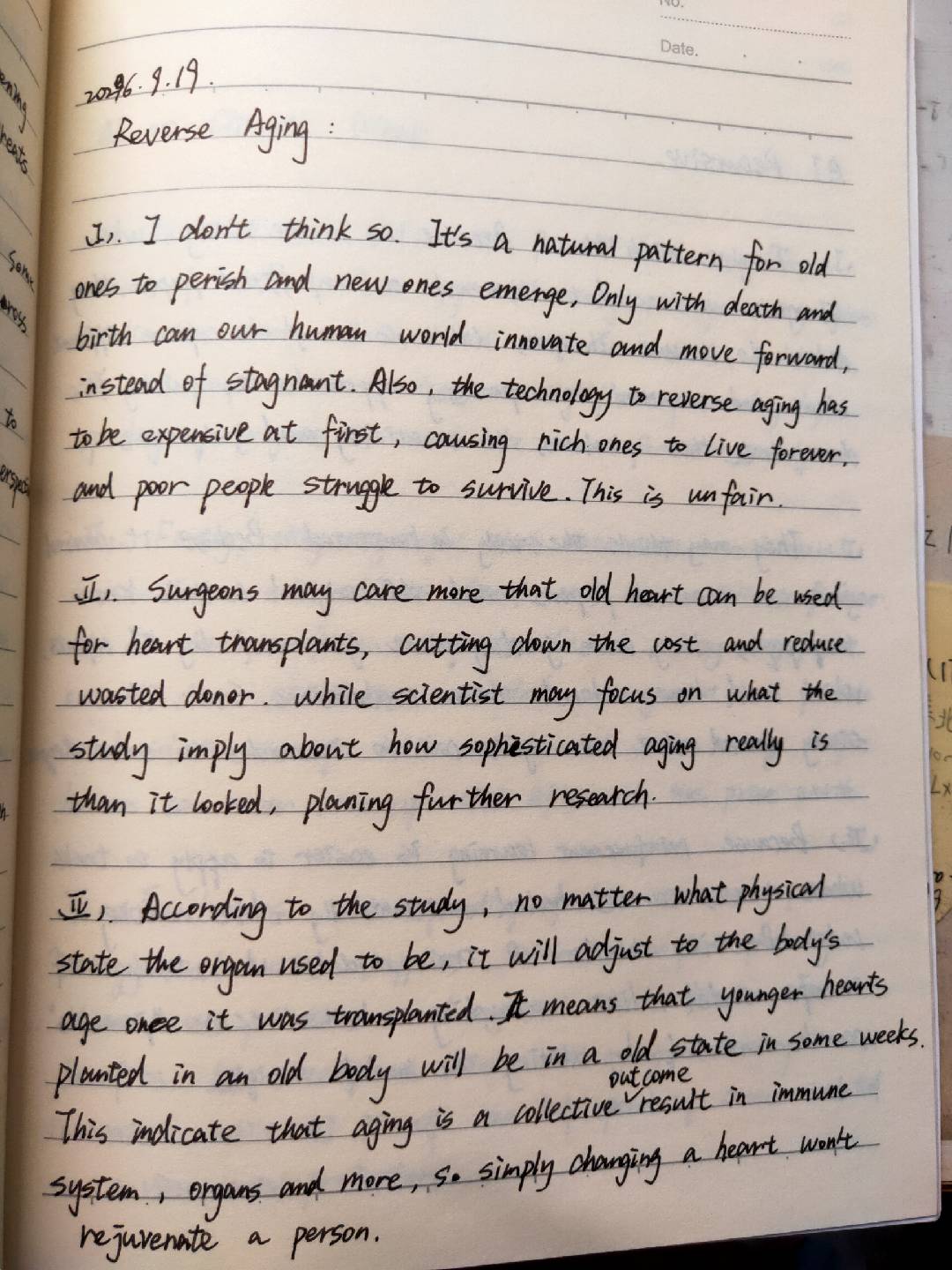
2026.9.19.
Reverse Aging :

I. I don't think so. It's a natural pattern for old
ones to perish and new ones emerge. Only with death and
birth can our human world innovate and move forward,
instead of stagnant. Also, the technology to reverse aging has
to be expensive at first, causing rich ones to Live forever.
and poor people struggle to survive. This is unfair.

II. Surgeons may care more that old heart can be used
for heart transplants, cutting down the cost and reduce
wasted donor. while scientist may focus on what the
study imply about how sophisticated aging really is
than it looked, planing further research.

III. According to the study, no matter what physical
state the organ used to be, it will adjust to the body's
age once it was transplanted. It means that younger hearts
planted in an old body will be in a old state in some weeks.
This indicate that aging is a collective outcome result in immune
system, organs and more, so. Simply changing a heart won't
rejuvenate a person.
Content is largely accurate and the three parts match the three prompts for the Young Organs article. Part II is the strongest: it correctly picks up the article's practical hope that surgeons will 'consider using hearts from older donors, many of which are discarded because they're assumed to not function as well.' Part I is a fair ethics argument (equity, death and renewal) but it never uses the article's own evidence, e.g. Poganik's 'There are aspects of biological age that are probably reversible, and there are aspects that are probably not,' or the 'Sorry, Putin' ending. Part III gets the mechanism roughly right but states it too confidently and gets the timeline wrong: the study measured hearts 'four to six months after surgery,' not 'in some weeks.' Phrasing: 'It's a natural pattern for old ones to perish and new ones emerge' → Suggest: 'It is natural for the old to die and the new to take their place.' 'instead of stagnant' → Suggest: 'instead of remaining stagnant.' 'causing rich ones to Live forever. and poor people struggle to survive' → Suggest: 'which would let the rich live forever while the poor struggle to survive' (also, don't capitalize 'Live' mid-sentence, and don't start a sentence with 'and' here). Tense: 'once it was transplanted' clashes with 'will adjust' → Suggest: 'once it is transplanted.' 'This indicate' → 'This indicates.' Focus next on conditional tense ('would have to be expensive,' not 'has to be') and on citing at least one article fact per answer.
No.

Date.

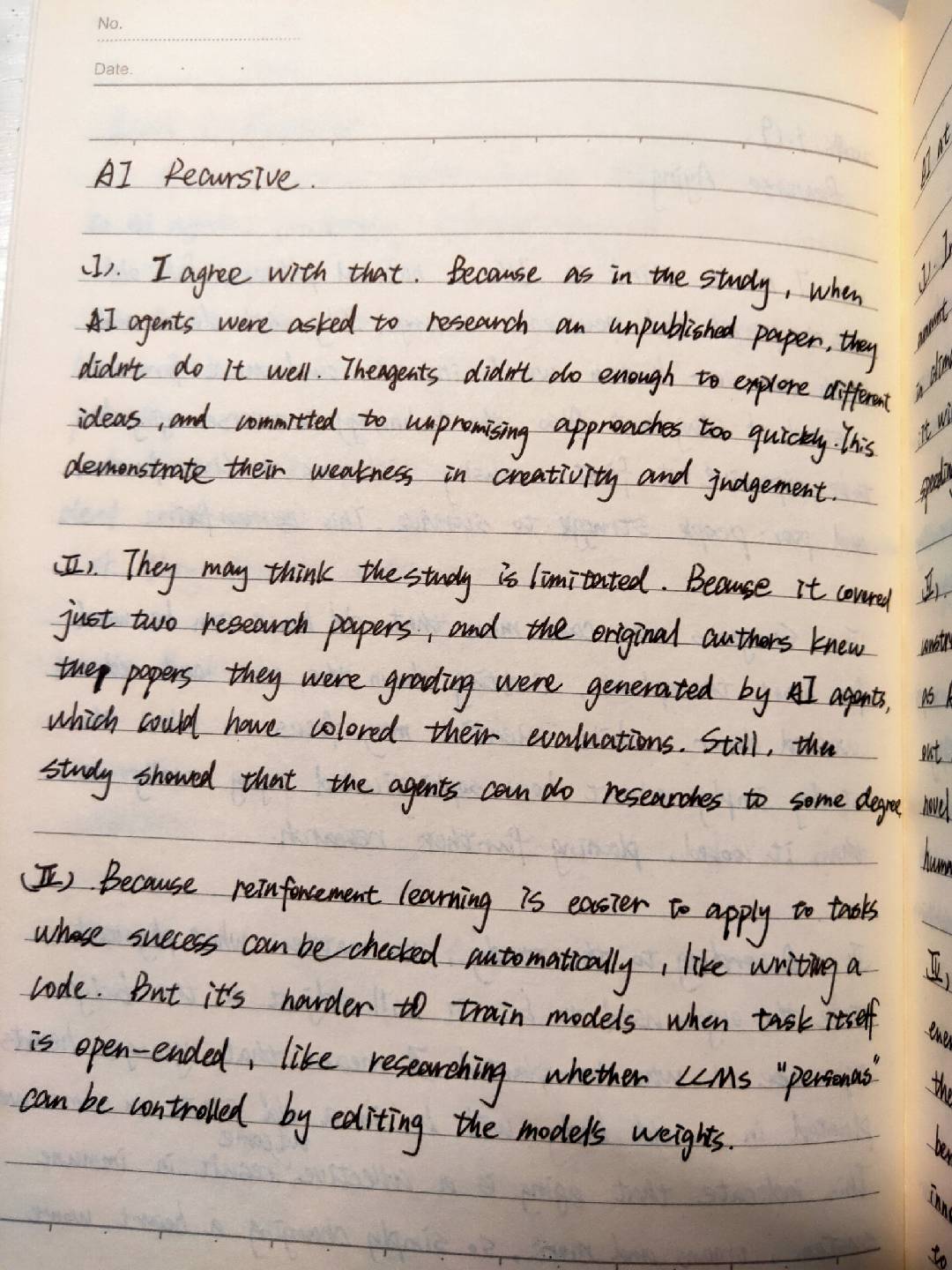
AI Recursive.

1.  I agree with that. Because as in the study, when
    AI agents were asked to research an unpublished paper, they
    didn't do it well. Theagents didn't do enough to explore different
    ideas, and commmitted to unpromising approaches too quickly. This
    demonstrate their weakness in creativity and judgement.

II. They may think the study is limitted. Because it covered
    just two research papers, and the original authors knew
    they papers they were grading were generated by AI agents,
    which could have colored their evaluations. Still, the
    study showed that the agents can do researches to some degree.

III.) Because reinforcement learning is easier to apply to tasks
    whose success can be checked automatically, like writing a
    code. But it's harder to train models when task itself
    is open-ended, like researching whether LLMs "personas"
    can be controlled by editing the model's weights.
Parts I and III show real understanding. Part I quotes the article almost verbatim ('didn't do enough to explore different ideas, and committed to unpromising approaches too quickly'), which is exactly the kind of evidence the prompt asked for. Part III correctly explains that reinforcement learning works when 'success can be checked automatically' and uses the article's own example (controlling LLM personas by editing weights). Part II, however, is muddled: after listing the study's limitations (only two papers, authors knew the papers were AI-generated), the student concedes 'the study showed that the agents can do researches to some degree,' which undercuts the assignment to argue from a believer's viewpoint. A stronger answer would add the article's counter-evidence — that GPT-5.6 Sol 'had helped post-train a smaller model' and that the team is now testing Mythos. Grammar to fix: 'Theagents' → 'The agents'; 'commmitted' → 'committed'; 'This demonstrate' → 'This demonstrates'; 'limitted' → 'limited'; 'they papers they were grading' → 'the papers they were grading'; 'do researches' → 'do research' (uncountable); 'like writing a code' → 'like writing code.' Also correct the fragment habit: 'I agree with that. Because as in the study...' → Suggest: 'I agree, because in the study, when AI agents were asked to research an unpublished paper, they didn't do it well.'
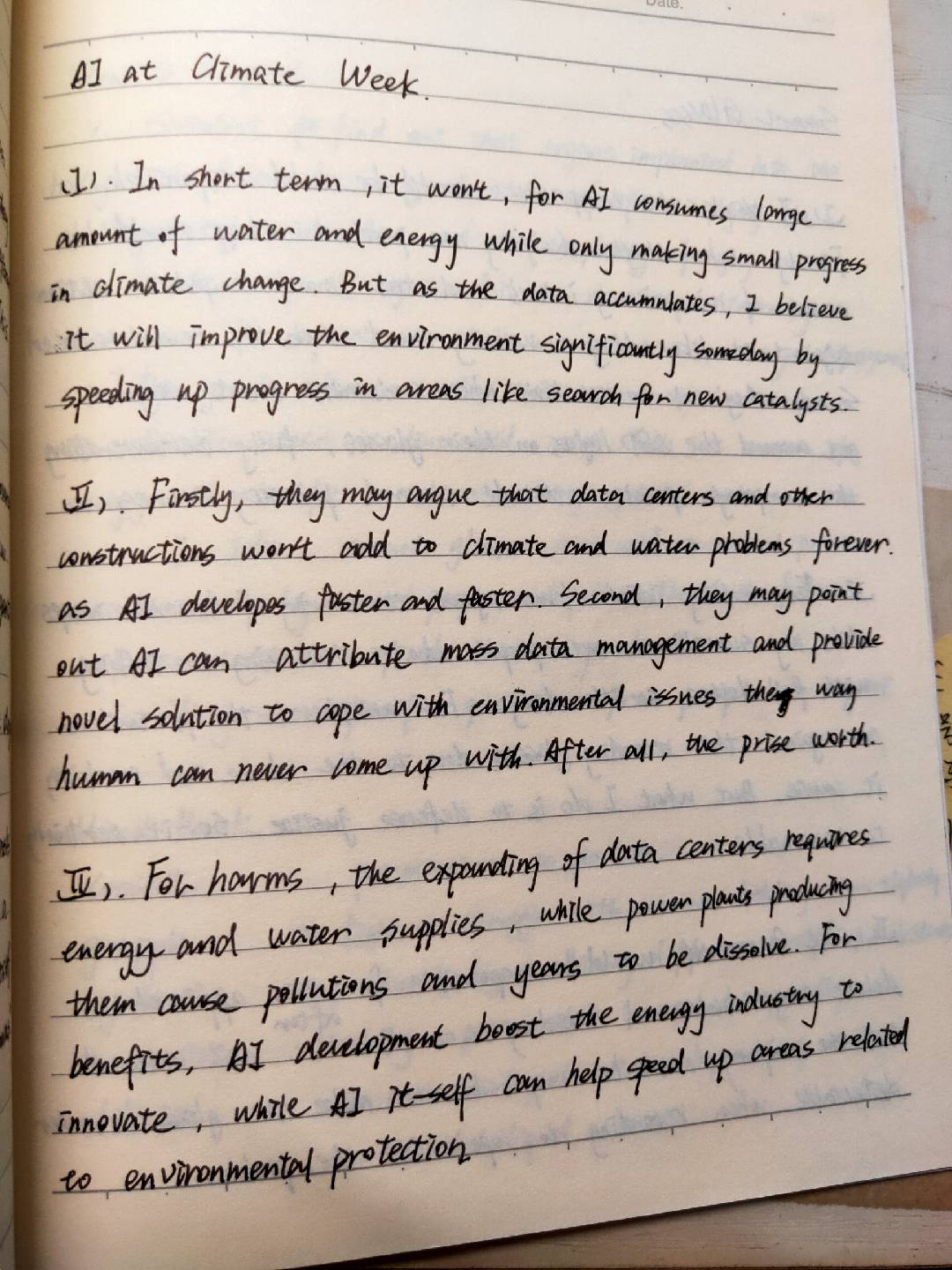
AI at Climate Week.

I. In short term, it won't, for AI consumes large
amount of water and energy while only making small progress
in climate change. But as the data accumulates, I believe
it will improve the environment significantly someday by
speeding up progress in areas like search for new catalysts.

Ⅱ. Firstly, they may argue that data centers and other
constructions won't add to climate and water problems forever.
as AI develops faster and faster. Second, they may point
out AI can attribute mass data management and provide
novel solution to cope with environmental issues they way
human can never come up with. After all, the prise worth.

Ⅲ. For harms, the expounding of data centers requires
energy and water supplies, while power plants producing
them cause pollutions and years to be dissolve. For
benefits, AI development boost the energy industry to
innovate, while AI itself can help speed up areas related
to environmental protection.
The student grasps both sides of the climate debate: AI's water and energy consumption now versus its long-run potential, quoting the article's catalyst example (Evelyn Wang) without attribution, and echoing Wang's claim that data centers 'will not add to climate and water problems forever.' Part III's harms/benefits split is a sensible structure. Word-level problems are the main weakness. 'the expounding of data centers' → the intended word is 'expansion' ('expound' means to explain at length). 'After all, the prise worth' → Suggest: 'After all, the prize is worth it' (spelling + missing verb). 'while power plants producing them cause pollutions and years to be dissolve' is unintelligible; the article says once built, plants 'have a decades-long lifetime,' so → Suggest: 'and the power plants that supply them cause pollution and will keep running for decades.' 'AI can attribute mass data management' → 'attribute' is the wrong verb (it means to credit a cause); → Suggest: 'AI can handle massive amounts of data.' Other fixes: 'In short term' → 'In the short term'; 'large amount' → 'a large amount'; 'provide novel solution' → 'provide novel solutions'; 'they way human can never come up with' → 'in ways humans could never come up with'; 'AI development boost' → 'boosts.' Also avoid sentence fragments: 'data centers and other constructions won't add to climate and water problems forever. as AI develops faster and faster.'
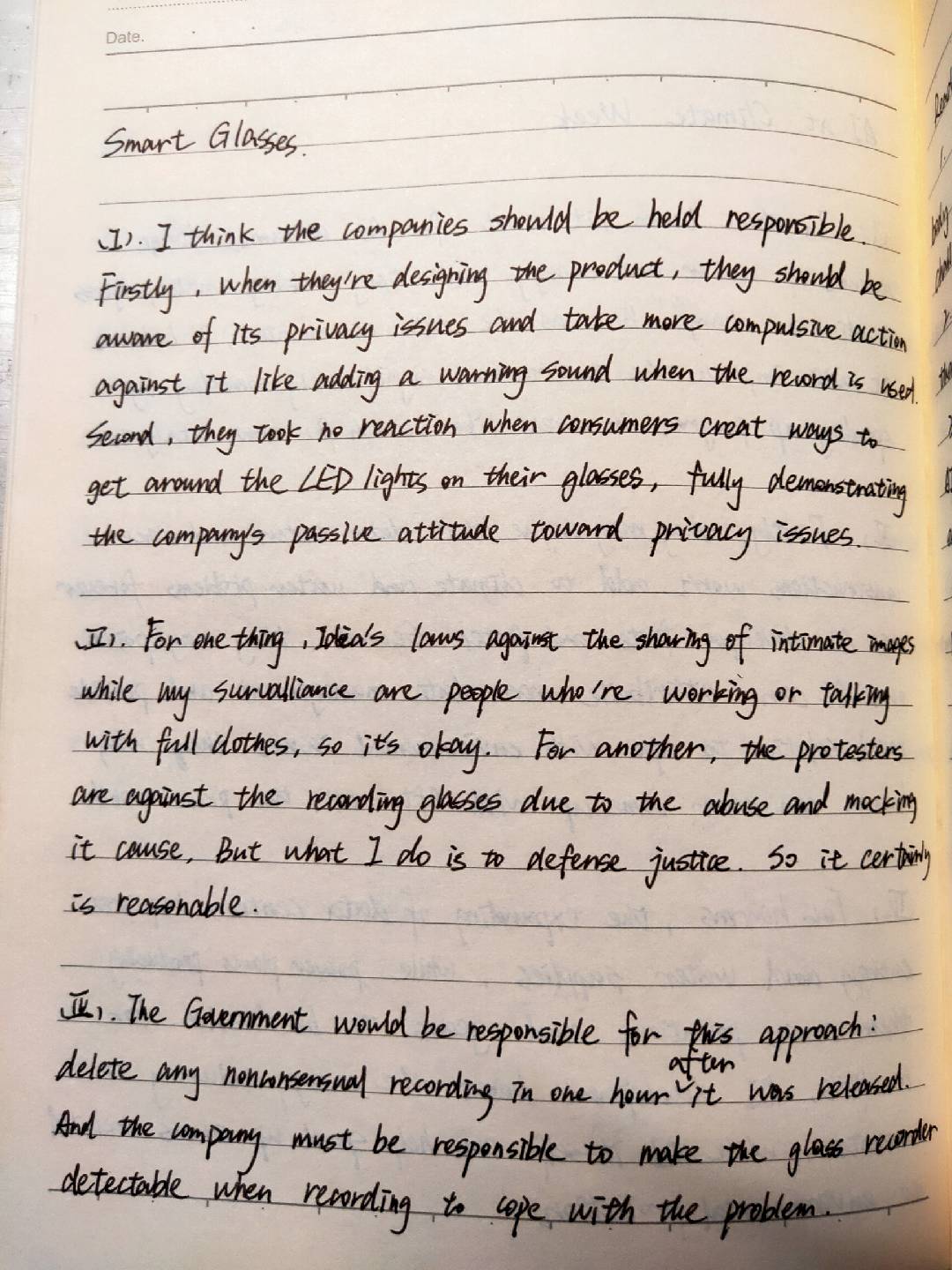
Date.

Smart Glasses.

1. I think the companies should be held responsible.
Firstly, when they're designing the product, they should be
aware of its privacy issues and take more compulsive action
against it like adding a warning sound when the record is used.
Second, they took no reaction when consumers creat ways to
get around the LED lights on their glasses, fully demonstrating
the company's passive attitude toward privacy issues.

11. For one thing, tolen's laws against the sharing of intimate images
while my survillance are people who're working or talking
with full clothes, so it's okay. For another, the protesters
are against the recording glasses due to the abuse and mocking
it cause. But what I do is to defense justice. So it certainly
is reasonable.

111. The Government would be responsible for this approach:
after
delete any nonnonsensual recording in one hour, it was released.
And the company must be responsible to make the glass recorder
detectable when recording to cope with the problem.
Part I is on target and draws on a real article detail — the 'stealth mode' modifications (Wired) that 'physically disable the light or remove it entirely,' and Meta's passive stance. It would be stronger if it also engaged Meta's defence ('Every pair has a capture LED... it can't be turned off, and if someone covers or damages the LED, the camera is disabled'). Part II is the weakest answer on any page: it garbles the law ('tolen's laws'), misreads the article — Apar Gupta says Indian law 'offer[s] limited protection when someone is secretly filmed in an ordinary public setting,' so a public recording is not automatically acceptable — and it never answers the prompt's request for what concerns the officer would have. 'But what I do is to defense justice' → Suggest: 'But I am upholding the law and defending public order' ('defence/defense' is a noun; use the verb 'defend' or 'uphold'). 'with full clothes' → 'fully clothed.' 'survillance' → 'surveillance.' 'it cause' → 'it causes.' Part III has a genuinely good solution — a one-hour takedown rule that tightens the article's 36-hour window, plus a company duty to make recording detectable — but it is nearly unreadable: 'after delete any nonnonsensual recording in one hour, it was released' → Suggest: 'Any non-consensual recording must be deleted within one hour of being posted.' Also fix 'nonnonsensual' → 'non-consensual' and 'compulsive action' → 'forceful action' ('compulsive' means obsessive).
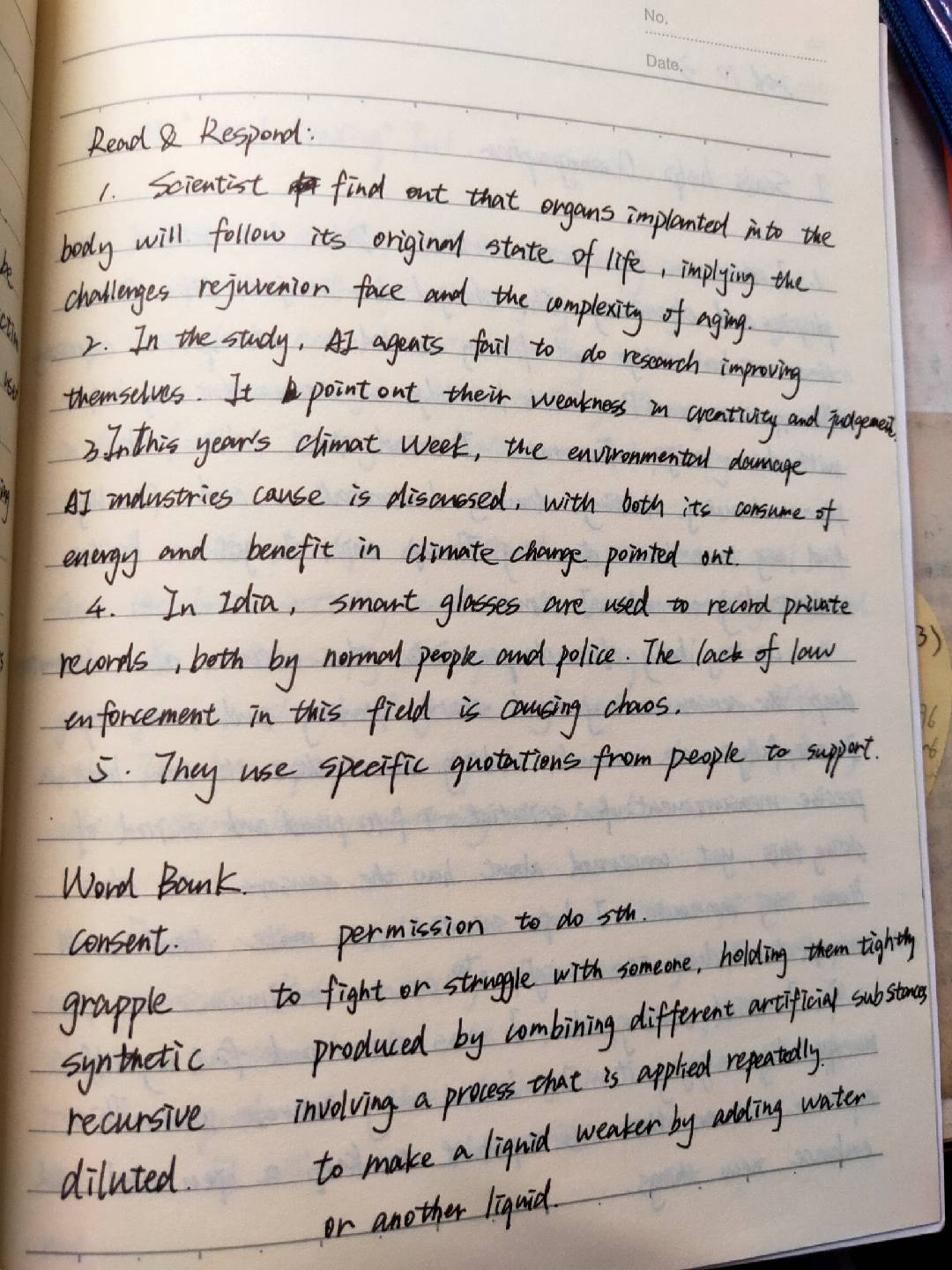
Read & Respond:
1. Scientist find out that organs implanted into the
body will follow its original state of life, implying the
challenges rejuvenation face and the complexity of aging.
2. In the study, AI agents fail to do research improving
themselves. It point out their weakness in creativity and judgement.
3. In this year's climat Week, the environmental damage
AI industries cause is discussed, with both its consume of
energy and benefit in climate change pointed out.
4. In Idia, smart glasses are used to record private
records, both by normal people and police. The lack of law
enforcement in this field is causing chaos.
5. They use specific quotations from people to support.

Word Bank.
consent. permission to do 5th.
grapple to fight or struggle with someone, holding them tightly
synthetic produced by combining different artificial substances
recursive involving a process that is applied repeatedly.
diluted. to make a liquid weaker by adding water
or another liquid.
The Read & Respond answers are all one sentence, so they meet the brief in form but are too vague to prove comprehension. Q1: 'organs ... will follow its original state of life' misses the article's key finding, that a new heart 'adopts the biological age of the person who received it'; → Suggest: 'Scientists found that transplanted organs adopt the biological age of the recipient, which shows how complicated aging and rejuvenation really are.' Also 'Scientist find out' → 'Scientists found' and 'challenges rejuvenation face' → 'faces.' Q3: 'climat' → 'climate'; 'consume' → 'consumption'; the answer omits the UN framing (Guterres, Stiell) and the 1.5 °C milestone. Q4 is the most inaccurate: 'Idia' → 'India'; 'record private records' is redundant → 'record people without consent'; and 'lack of law enforcement' misdiagnoses the article, which says the law 'has not caught up' while police themselves use the glasses — so → Suggest: 'the lack of legal protection.' Q5 is only a fragment: 'They use specific quotations from people to support' names neither the article nor a single quotation. For the Smart Glasses piece it should cite Shubnam's quote ('All it took was one unconsented video to rewind two decades of progress'), Świerczyński, Sameer Parmar, Apar Gupta, the IDC market data, and the Delhi High Court petition. The Word Bank entries are fragments missing the verb 'to be': 'recursive involving a process' → 'recursive: involving a process'; and 'consent. permission to do 5th' is unclear.
✏️ Grammar & Spelling
| Original | Correction |
|---|
| instead of stagnant | instead of remaining stagnant |
| has to be expensive | would have to be expensive |
| rich ones to Live forever | the rich to live forever |
| reduce wasted donor | reducing wasted donor organs |
| scientist may focus | scientists may focus |
| the study imply | the study implies |
| planing | planning |
| once it was transplanted | once it is transplanted |
| in a old state | in an old state |
| in some weeks | within a few months |
| This indicate | This indicates |
| Theagents | The agents |
| commmitted | committed |
| This demonstrate | This demonstrates |
| judgement | judgment |
| limitted | limited |
| they papers they were grading | the papers they were grading |
| do researches | do research |
| like writing a code | like writing code |
| when task itself is open-ended | when the task itself is open-ended |
| In short term | In the short term |
| consumes large amount of water | consumes a large amount of water |
| provide novel solution | provide novel solutions |
| AI can attribute mass data management | AI can handle massive amounts of data |
| they way human can never come up with | in ways humans could never come up with |
| After all, the prise worth. | After all, the prize is worth it. |
| the expounding of data centers | the expansion of data centers |
| cause pollutions | cause pollution |
| years to be dissolve | decades to be phased out |
| AI development boost | AI development boosts |
| consumers creat ways | consumers create ways |
| take more compulsive action | take more forceful action |
| when the record is used | when recording is in progress |
| they took no reaction | they did nothing |
| tolen's laws | India's laws |
| my survillance | my surveillance |
| people who're working or talking with full clothes | people who are working or talking while fully clothed |
| the abuse and mocking it cause | the abuse and mocking it causes |
| what I do is to defense justice | what I am doing is upholding the law |
| nonnonsensual | non-consensual |
| after delete any nonnonsensual recording in one hour, it was released | any non-consensual recording must be deleted within one hour of being posted |
| Scientist find out | Scientists found |
| the challenges rejuvenation face | the challenges rejuvenation faces |
| It point out | It points out |
| climat Week | Climate Week |
| its consume of energy | its consumption of energy |
| In Idia | In India |
| record private records | record people without their consent |
| The lack of law enforcement in this field | The lack of legal protection in this field |
📝 Transcribed Text
Click to expand each section.
Comprehension Check
Read & Respond: 1. Scientist find out that organs implanted into the body will follow its original state of life, implying the challenges rejuvenation face and the complexity of aging.
Vocab Builder
Read & Respond: 2. In the study, AI agents fail to do research improving themselves. It point out their weakness in creativity and judgement. / Word Bank. consent. permission to do 5th. grapple to fight or struggle with someone, holding them tightly synthetic produced by combining different artificial substances recursive involving a process that is applied repeatedly. diluted. to make a liquid weaker by adding water or another liquid.
Critical Thinking
PAGE 1 — Reverse Aging (Young Organs): I. I don't think so. It's a natural pattern for old ones to perish and new ones emerge. Only with death and birth can our human world innovate and move forward, instead of stagnant. Also, the technology to reverse aging has to be expensive at first, causing rich ones to Live forever. and poor people struggle to survive. This is unfair. II. Surgeons may care more that old heart can be used for heart transplants, cutting down the cost and reduce wasted donor. while scientist may focus on what the study imply about how sophisticated aging really is than it looked, planing further research. III. According to the study, no matter what physical state the organ used to be, it will adjust to the body's age once it was transplanted. It means that younger hearts planted in an old body will be in a old state in some weeks. This indicate that aging is a collective outcome result in immune system, organs and more, so. Simply changing a heart won't rejuvenate a person.

PAGE 2 — AI Recursive: 1. I agree with that. Because as in the study, when AI agents were asked to research an unpublished paper, they didn't do it well. Theagents didn't do enough to explore different ideas, and commmitted to unpromising approaches too quickly. This demonstrate their weakness in creativity and judgement. II. They may think the study is limitted. Because it covered just two research papers, and the original authors knew they papers they were grading were generated by AI agents, which could have colored their evaluations. Still, the study showed that the agents can do researches to some degree. III. Because reinforcement learning is easier to apply to tasks whose success can be checked automatically, like writing a code. But it's harder to train models when task itself is open-ended, like researching whether LLMs 'personas' can be controlled by editing the model's weights.

PAGE 3 — AI at Climate Week: I. In short term, it won't, for AI consumes large amount of water and energy while only making small progress in climate change. But as the data accumulates, I believe it will improve the environment significantly someday by speeding up progress in areas like search for new catalysts. II. Firstly, they may argue that data centers and other constructions won't add to climate and water problems forever. as AI develops faster and faster. Second, they may point out AI can attribute mass data management and provide novel solution to cope with environmental issues they way human can never come up with. After all, the prise worth. III. For harms, the expounding of data centers requires energy and water supplies, while power plants producing them cause pollutions and years to be dissolve. For benefits, AI development boost the energy industry to innovate, while AI itself can help speed up areas related to environmental protection.

PAGE 4 — Smart Glasses: 1. I think the companies should be held responsible. Firstly, when they're designing the product, they should be aware of its privacy issues and take more compulsive action against it like adding a warning sound when the record is used. Second, they took no reaction when consumers creat ways to get around the LED lights on their glasses, fully demonstrating the company's passive attitude toward privacy issues. 11. For one thing, tolen's laws against the sharing of intimate images while my survillance are people who're working or talking with full clothes, so it's okay. For another, the protesters are against the recording glasses due to the abuse and mocking it cause. But what I do is to defense justice. So it certainly is reasonable. 111. The Government would be responsible for this approach: after delete any nonnonsensual recording in one hour, it was released. And the company must be responsible to make the glass recorder detectable when recording to cope with the problem.

PAGE 5, Q3 — Read & Respond: 3. In this year's climat Week, the environmental damage AI industries cause is discussed, with both its consume of energy and benefit in climate change pointed out.
See It Differently
Read & Respond: 4. In Idia, smart glasses are used to record private records, both by normal people and police. The lack of law enforcement in this field is causing chaos.
Quick Write
Read & Respond: 5. They use specific quotations from people to support.